When Can You Find Out Your Baby's Gender?

A NIPT blood test can tell you your baby's sex from about 10 weeks with ~99% accuracy. A skilled reading of the 12-week scan (nub theory) gets it right roughly 9 times in 10, and the 18–22 week anatomy scan, where most parents find out, is about 99% accurate with a clear view. At-home DNA tests push the earliest possible answer to around 6–7 weeks. Everything earlier or cheaper than that, from calendars to heart rates and cravings, performs at coin-flip level.
Here is every method side by side, then what changes week by week.
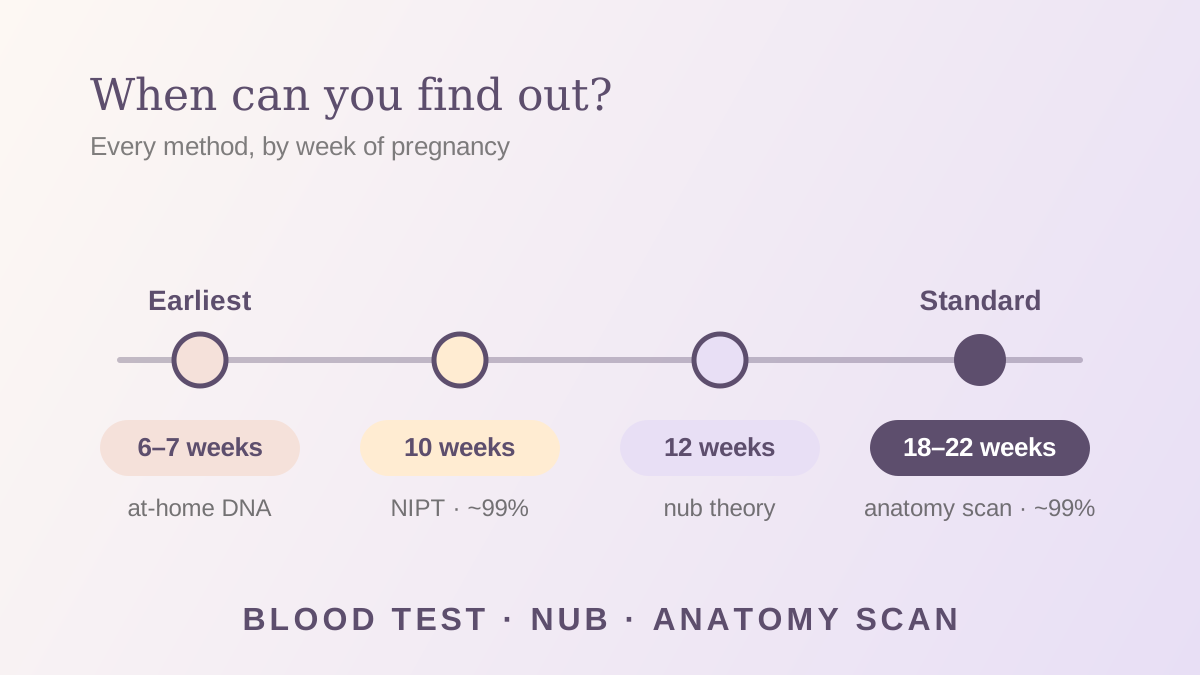
Every Method Compared: How Early, How Accurate
| Method | From what week | Accuracy | Worth knowing |
|---|---|---|---|
| At-home cfDNA test (SneakPeek-type) | ~6–7 weeks | ~95–99% when the sample is clean | Detects fetal DNA in the mother's blood; contamination with someone else's DNA is the classic failure mode |
| NIPT (clinical blood test) | ~10 weeks | ~99%+ | Ordered through your provider; sex is reported alongside chromosome screening |
| Nub theory (12-week scan) | 11–13 weeks | ~87–92% at 12 weeks for trained readers | Reads the angle of the genital tubercle; see our full nub theory guide |
| CVS / amniocentesis | 10–13 / 15–20 weeks | ~100% | Diagnostic DNA tests done for medical reasons; sex is incidental, nobody orders them just for gender |
| Anatomy scan | 18–22 weeks | ~99% with a clear view | The standard route; can still be wrong if position hides the view |
| Old-wives methods (calendars, heart rate, bump shape) | any week | ~50% | Fun, but statistically a coin flip |
No method is 100%. Even the anatomy scan misses occasionally when a baby refuses to cooperate. The only near-certain answers come from DNA (NIPT, CVS, amniocentesis).
Can You Find Out the Gender at 10 Weeks?
Yes, but only from blood rather than a scan. From about 10 weeks a clinical NIPT (non-invasive prenatal test) detects fragments of fetal DNA circulating in the mother's bloodstream and reports sex with ~99%+ accuracy. At-home versions of the same cfDNA technology claim results from as early as 6–7 weeks.
On an ultrasound at 10 weeks there is nothing to see: the genital tubercle, the structure that becomes either a penis or a clitoris, looks identical in boys and girls at this stage. Any 10-week ultrasound gender call is a guess. This is the gap that early-scan folklore fills: Ramzi theory reads the placenta's side at 6–8 weeks and skull theory reads head shape at 12, and both perform at about 50%.
Can You Find Out the Gender at 12 Weeks?
Sometimes, and this is where nub theory enters. On a good side-profile image from the 12-week (dating/NT) scan, the angle of the genital tubercle against the lower spine hints at sex: pointing up more than 30° suggests a boy, running parallel suggests a girl. Published studies show trained readers reach roughly 87–92% accuracy at 12 weeks, climbing into the high 90s by week 13, but only when the scan captures a clean mid-sagittal profile, which many keepsake printouts don't. We break down the studies, the angles and the failure modes in the nub theory guide.
Can You Find Out the Gender at 14 Weeks?
Odds improve. By 14 weeks the external genitalia themselves are starting to be distinguishable, not just the nub angle, and a cooperative baby plus a good sonographer can produce a confident call. Position is still the deciding factor: legs crossed at 14 weeks means no answer, same as at 12.
Is 16 Weeks Too Early to Find Out?
No, 16 weeks is usually enough. By now most sonographers can identify sex on a decent between-the-legs view in the large majority of pregnancies. Many elective "gender determination" scans are booked at 15–16 weeks for this reason. The caveat stays the same: a stubborn position or the cord between the legs can still postpone the answer to the anatomy scan.
18 to 20 Weeks: The Anatomy Scan
This is when most parents officially find out. The 18–22 week anatomy scan examines your baby head to toe, and sex determination rides along at about 99% accuracy when the view is clear. It's also the scan where "boy or girl?" is the least of what's being checked. Organs, growth and placenta all get measured, which is why this scan is medically standard while earlier gender peeks are optional extras. If you're choosing when to book a keepsake 3D/4D session instead, that's a different calculation, because face clarity peaks later, at 26–32 weeks.
One note: anatomy-scan gender calls are very good but not infallible. Wrong calls happen in a low single-digit percentage of cases, almost always because of position or image quality.
What Determines Your Baby's Gender?
Sex was settled at conception, long before any test can read it. Eggs always carry an X chromosome; sperm carry either an X or a Y. An X-carrying sperm makes an XX embryo (a girl), a Y-carrying sperm makes XY (a boy). Every method on this page is a different way of reading that already-decided fact: DNA tests look for Y-chromosome fragments in the mother's blood, and ultrasound waits for the anatomy driven by those chromosomes to become visible.
That's also why the sex "reveal" timeline is really a detection timeline. Nothing about your baby's sex changes between week 6 and week 20; only your ability to see it does.
Can You Choose Your Baby's Gender?
For natural conception, no. Timing methods, diets, positions and lunar calendars have all been studied and none shifts the odds meaningfully away from ~50/50.
The only method that actually works is PGT (preimplantation genetic testing) during IVF: embryos are created in the lab, tested, and an embryo of known sex is transferred. It's expensive, medically involved, and in many countries sex selection for non-medical reasons is restricted or prohibited. Everything else sold as "gender swaying" is folklore with a price tag.
Can You Find Out Without an Ultrasound?
Yes. The blood tests above don't involve a scan at all. NIPT from ~10 weeks (or an at-home cfDNA kit from ~6–7 weeks) reads fetal DNA directly and beats every ultrasound method on both timing and accuracy.
Beyond blood, the folklore aisle is long: the Chinese lunar calendar, the Mayan calendar, heart rate above or below 140, carrying high or low, morning-sickness severity, cravings for sweet versus salty. They're fun, and every one of them lands at about 50% accuracy, because none has a biological mechanism connecting it to your baby's chromosomes. If you enjoy them, enjoy them as entertainment while the NIPT results are in the mail.
Checking Your Own Scan Photo
If you already have an ultrasound photo from any week, there's a faster way to know whether it contains a gender clue. Our free ultrasound gender predictor looks at your image the way a sonographer would, nub angle on an early profile and the classic anatomy-scan signs later, and gives a boy-or-girl guess with a confidence score. When the image doesn't show enough (most face-focused 3D renders don't), it says "unclear" instead of inventing an answer. It's a for-fun tool rather than a diagnosis, and it reports what your particular photo does and doesn't show.
FAQ
When can you find out gender with NIPT?
From about 10 weeks of pregnancy. NIPT analyzes fetal DNA fragments in the mother's blood and reports sex with ~99%+ accuracy, usually within a week or two of the draw.
Can the 12-week scan tell gender?
Sometimes. If the scan captures a clean side profile, the nub angle suggests sex with roughly 87–92% accuracy in trained hands at 12 weeks. It is a hint rather than a guarantee, and position and image quality decide whether a reading is possible at all.
How early can you find out your baby's gender?
Around 6–7 weeks with an at-home cfDNA blood test, about 10 weeks with clinical NIPT. On ultrasound alone, meaningful guesses start at 12 weeks and near-certainty arrives with the 18–22 week anatomy scan.
Is 16 weeks too early for a gender scan?
Usually not. By 16 weeks sex can be identified in the vast majority of pregnancies when the baby's position allows a clear view, which is why many elective gender-determination scans are booked at 15–16 weeks.
Can an ultrasound gender prediction be wrong?
Yes. Even anatomy-scan calls are wrong in a small percentage of cases, and earlier nub-based readings are wrong roughly 1 time in 10. Blood-based DNA tests (NIPT, CVS, amnio) are the only near-certain answers.
Sources
- ACOG: Ultrasound Exams FAQ
- Mayo Clinic: Prenatal cell-free DNA screening
- WebMD: Ultrasound to Learn Baby's Sex
- Efrat et al.: Fetal gender assignment by first-trimester ultrasound
Already Have a Scan Photo?
Ask the AI what it shows. Free, instant, and clear about uncertainty.
Try the free ultrasound gender predictor
This article is general information, not medical advice. Prenatal testing decisions belong with your OB-GYN or midwife.