Is There a Gender Code Hidden in Your Ultrasound Report?
Almost certainly not. If your baby's sex isn't written on the ultrasound report, the overwhelmingly likely explanation is that it wasn't assessed. When fetal sex is recorded, it is tied to a clear field or sentence about the fetus. A standalone M/F elsewhere may describe the patient, and the "secret codes" that circulate on pregnancy forums are almost all misreadings of routine technical fields.
This guide covers what the markings mean, why the sex line is so often missing, and how to get an answer from your own scan.
What Gender Markings Actually Appear on Reports
When a clinic does record fetal sex, it doesn't hide it. You'll see one of a handful of plain formats:
- "Fetal sex: male / female" or M / F in a field explicitly labelled for the fetus.
- A sentence in the findings, e.g. "external genitalia appear male."
- "Fetal sex: not assessed" / "unable to determine" / a blank field, meaning no fetal-sex result was recorded.
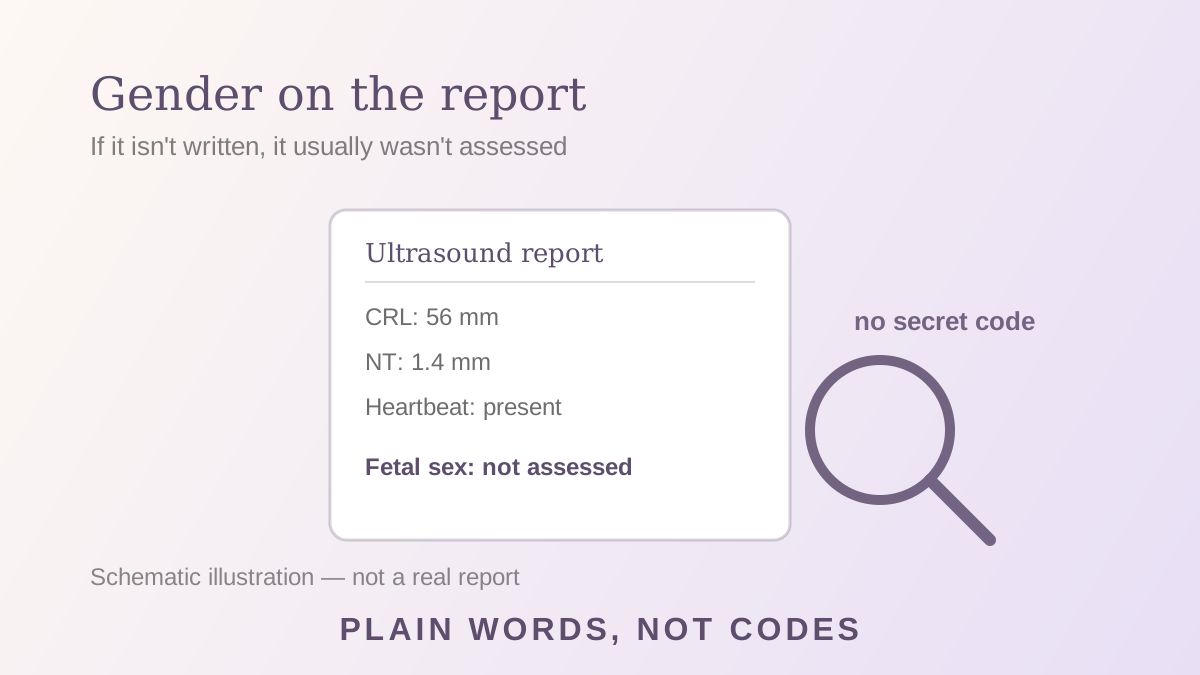
Other markings that confuse people:
- A standalone M or F can describe the pregnant patient, especially near the name, date of birth or other demographics. Without a field label tying it to the fetus, it is not a fetal-sex result.
- XX / XY belongs to DNA results such as NIPT, CVS or amniocentesis reports. Ultrasound can't see chromosomes, so a scan report itself won't state a karyotype.
- "External genitalia: normal" is an anatomy-check line, not a sex disclosure. "Normal" here means "developing as expected," and it's deliberately sex-neutral phrasing.
The "Secret Code" Myth, Debunked
Forum threads regularly claim clinics hide the sex in the report, in scan codes, in image numbers, in abbreviations only staff understand. Almost none of this survives contact with how reports are written:
- Technical fields aren't about your baby. Machine settings, probe codes, image indices, billing codes (like CPT 76805) describe the equipment and the procedure, not the sex.
- Sonographer slang isn't in the report. Terms parents pick up online, the "three lines" (labia) or the "dome sign" (scrotum), describe what sonographers look for on screen during a scan. They're visual signs rather than notations someone writes down in coded form.
- The simplest explanation wins. Report writing is a medical-legal document trail. Clinics either record a finding plainly or don't record it. A clinic with a policy (or legal duty) not to disclose sex doesn't write it in invisible ink; it doesn't assess it, or doesn't put it in the copy you receive.
So if you're scanning your report for a hidden signal, the absence of a sex line is itself the answer. It usually means nobody made the call.
How Sonographers Actually Check Gender
In a clinical sonography exam where sex determination is permitted and requested, the sonographer looks directly at the external genitalia, typically from 18–22 weeks when the anatomy is clearly distinguishable. The classic signs are the three parallel lines of the labia for a girl and the dome sign (scrotum and penis) for a boy. Earlier, from about 12 weeks, only the indirect nub angle method exists, with real error rates; our nub theory guide covers them. Anything earlier or fancier than that is either a DNA test or folklore, and the full method-by-method timeline compares them all.
Why Your Report Doesn't Mention Sex
The mundane reasons, in rough order of likelihood:
- It wasn't assessed. At dating and NT scans, sex isn't on the protocol checklist. The sonographer was measuring what medicine needed measured.
- Clinic policy. Many clinics don't record or disclose sex before a certain week (often 16), or leave it out of reports entirely so a guess never reads as a finding. This is especially routine at the 12-week scan, where gender is a maybe at best.
- You asked for a surprise, or someone on the care team thought you did. Reports often omit sex when the notes flag it.
- The view wasn't there. Legs crossed, cord in the way, no reliable call possible, so nothing was recorded.
- The law prohibits it. In some countries, disclosing fetal sex is illegal, which deserves its own section.
Where Telling You Is Against the Law, and Why
In India, the PCPNDT Act (1994) makes disclosing fetal sex illegal at any stage of pregnancy, for everyone. Clinics must display a sign saying exactly that, patients show ID and sign declarations, and violations carry criminal penalties. Similar restrictions exist in some other countries.
The reason deserves respect rather than a workaround: these laws exist because prenatal sex disclosure was being used at scale for sex-selective abortion, skewing entire birth ratios. The law protects daughters rather than targeting curious parents. If you're in a country with such a law, there is no legal "code," no legitimate paid decoder, and anyone offering to reveal your baby's sex is offering to break a law that exists for a serious reason. We don't help with that, and neither should anyone else.
(Outside such jurisdictions, in places like the US or UK, you generally have a right to your medical records. If sex was assessed and recorded, you can request your full report rather than decode anything.)
The Honest Way to Read Your Own Scan
If you're outside restricted jurisdictions and curious about the photo in your hand, you don't need codes. The image itself is the source:
- 12-week profile shot? The nub angle is the one real first-trimester signal; here's how it works, studies included.
- 18+ week scan? The anatomy signs above may be visible in your printout if the view cooperated.
- Not sure what you're looking at? Our free ultrasound gender predictor reads your photo the way a sonographer would, nub angle early and anatomy signs later, and gives a boy-or-girl guess with a confidence score, or "unclear" when the image doesn't support a call. For fun rather than diagnosis; your photo is never stored. And wherever local law restricts sex disclosure, that law applies to AI tools too, so please follow it.
FAQ
Is the gender written on an ultrasound report?
Only if it was assessed and the clinic's policy is to record it. Then it appears in a field explicitly labelled for fetal sex or in a sentence about external genitalia. At first-trimester scans you may see "not assessed" or no mention at all.
What does M or F mean on an ultrasound report?
It depends on the field label. In a field explicitly labelled "fetal sex," M/F means male/female. In the patient-demographics section, F usually refers to the pregnant patient. An isolated letter without context is not enough to identify fetal sex; ask the clinic that issued the report.
Is there a secret code for gender on ultrasound reports?
No. Technical numbers on reports describe equipment, images and billing, not sex. Terms like "three lines" or "dome sign" are on-screen visual signs sonographers use, not coded report entries. A missing sex line almost always means it wasn't assessed.
Why won't the clinic tell me my baby's gender?
Common reasons: it wasn't part of the scan's medical protocol, the clinic doesn't make calls before ~16 weeks, the view wasn't clear enough for a reliable answer, or local law (as in India under the PCPNDT Act) prohibits disclosure entirely.
Is it legal to find out your baby's gender?
Depends on where you are. In most Western countries, yes, and it's routinely shared at the anatomy scan on request. In India and some other countries, prenatal sex disclosure is illegal for everyone, a law enacted to stop sex-selective abortion.
Sources
- PocketHealth: Finding out your baby's gender on ultrasound
- NHS GGC clinical guideline: Fetal gender determination and disclosure
- PC-PNDT Act: handbook for medical professionals — Ministry of Health and Family Welfare, India
- MadeForMums: Do 3 lines on an ultrasound mean it's a girl?
Have a Scan Photo Instead of a Code?
The image beats the paperwork. Upload it and see what's visible.
Try the free ultrasound gender predictor
This article is general information, not medical advice. Prenatal testing decisions belong with your OB-GYN or midwife. Local laws on sex disclosure apply everywhere, including to online tools.