Will You Find Out Your Baby's Gender at the 12-Week Ultrasound?
Probably not officially. The 12-week ultrasound is for dating and early assessment, and it may include an NT measurement if you choose combined screening. Gender isn't a routine endpoint, many clinics have a policy of not calling it this early, and even a confident guess at this stage is right roughly 9 times in 10, not 99. Some sonographers will still take a peek if you ask and the baby cooperates.
This guide covers what the appointment checks, what a gender guess at 12 weeks is worth, and what to do with the scan photo you'll walk out with.
What the 12-Week Scan Is Actually For
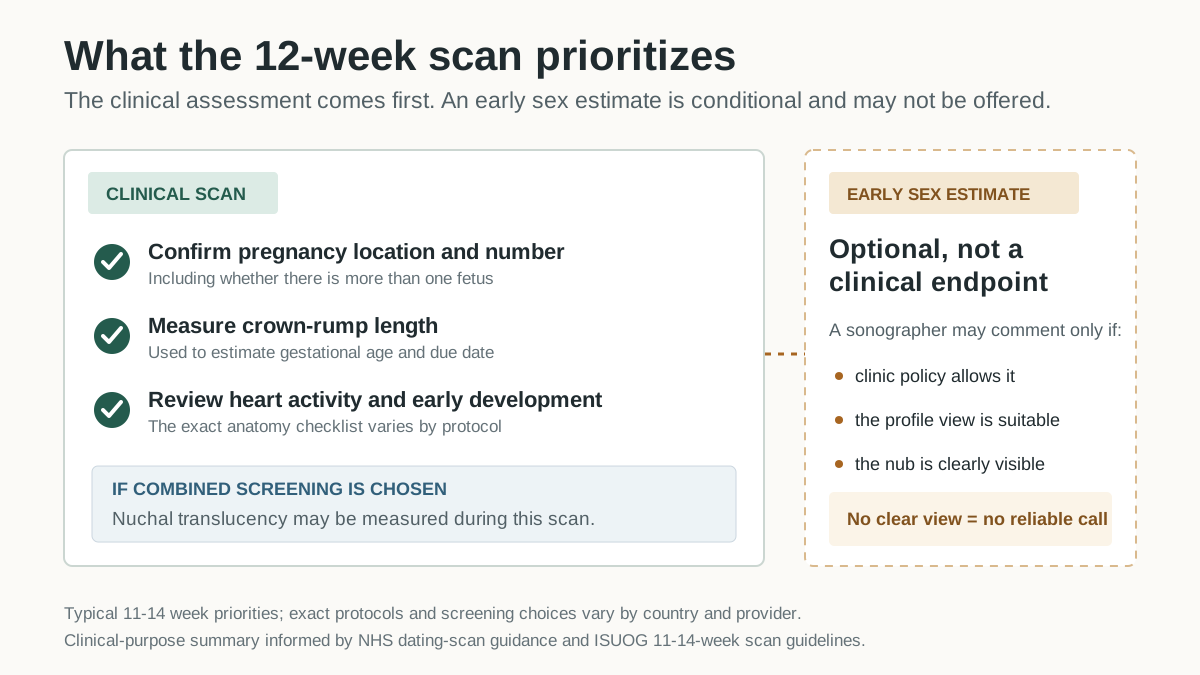
The scan you have around 11–14 weeks goes by several names (dating scan, NT scan, first-trimester screening), and none of them is "gender scan." The clinical checklist comes first; the diagram separates the appointment's medical purpose from an optional early-sex estimate.
What Can You Actually See at 12 Weeks?
Less than most parents hope. External genitals exist by week 12, but boys and girls still look nearly identical from the outside. The visible difference at this stage is the angle of the genital tubercle (the "nub") on a side-profile view. Reading that angle is its own method, called nub theory, and we cover the angles, the studies and the week-by-week numbers in our full nub theory guide.
On a good profile image, trained readers get the nub call right about 87–92% of the time at 12 weeks. That's better than a coin flip, and still wrong about one call in ten, which is why many clinics would rather say nothing than start a nursery repaint on a maybe.
Can You Ask the Sonographer to Look?
Yes, and plenty of parents do. Whether you get an answer depends on the clinic:
- Some will take a look at the end of the appointment if screening went smoothly, the baby is positioned well, and there's a minute to spare. Expect it to be framed as a guess.
- Many have a no-calls-before-16-weeks policy. Not because they're withholding a known fact: at 12 weeks the error rate is high enough that a wrong call causes real upset, and the appointment's medical checklist comes first.
- Some countries prohibit it entirely. In India and several other countries, disclosing fetal sex is against the law at any week. If that's your situation, the clinic's silence is legal compliance rather than policy preference. We explain what ultrasound reports do and don't say about sex, and why, in our guide to gender on ultrasound reports.
If the sonographer declines, it isn't personal and it isn't a clue in either direction. "Too early to say" at 12 weeks is the accurate statement.
"The Sonographer Said Boy": How Much Should You Trust It?
A 12-week guess from a professional beats folklore, but it's still a guess. A study of routine-practice sonographers, not researchers working on ideal images, found that in the 11–14 week window they committed to a call in 87% of scans. Across all first-trimester scans, only about three-quarters walked away with a correct determination; when sonographers did commit, they were right about 91% of the time. So roughly one family in ten walking out with a confident early answer got the wrong one.
Treat a 12-week call as a strong lean rather than a fact. Reasonable rules of thumb:
- Don't buy the paint yet. Wait for a confirming source before decisions you'd hate to undo.
- A hedged answer ("looks like a girl, but don't hold me to it") means exactly what it says.
- A confident answer at 12 weeks from anyone (sonographer, forum, app) still carries that ~1-in-10 error rate.
When and How Do You Get a Real Answer?
If the 12-week scan leaves you without an answer, or with one you want confirmed, these are the actual next steps. Full details on every method are in our guide to when you can find out your baby's gender:
| Option | When | Accuracy |
|---|---|---|
| NIPT blood test | available now (from ~10 weeks) | ~99%+ |
| Elective gender scan | usually booked at 15–16 weeks | very high with a clear view |
| Anatomy scan | 18–22 weeks, already scheduled for you | ~99% with a clear view |
NIPT is the strongest option on that list. At 12 weeks you're already past the 10-week threshold, so a blood draw today can give you a ~99% answer within days, with no waiting for a scan window and no dependence on the baby's mood. If you'd rather see than test, elective "gender determination" scans are commonly booked at 15–16 weeks, when the anatomy itself becomes readable rather than just a nub angle. And if you're planning a keepsake 3D/4D session anyway, that's a separate timing question: face clarity peaks much later, at 26–32 weeks.
What to Do With Your 12-Week Scan Photo
You'll leave the appointment with at least one printout, and what it can tell you depends on which view got captured:
- A profile shot (the classic NT-scan pose, head and spine in side view) is the one that can hold a gender clue. If the lower spine and rump are visible, the nub may be readable.
- A face-on or top-down view is lovely for the fridge but carries no gender information at this week.
If you got a profile shot, you can do what forum nub-readers do and compare angles against the nub theory guide. Or you can skip the squinting: our free ultrasound gender predictor reads the image the same way. It looks for the nub, evaluates its angle against the spine line, and answers boy or girl with a confidence score. When your photo doesn't show a readable nub, which at 12 weeks is common, it says "unclear" instead. It's a for-fun tool, not a diagnosis, and your photo is never stored.
FAQ
Can they tell the gender at a 12 week scan?
Sometimes, but it's not what the scan is for. The appointment focuses on dating and early development, with NT measurement included when combined screening is chosen and the timing fits. If the baby's position allows, some sonographers will offer a guess based on the nub angle, which is right roughly 87–92% of the time in trained hands. Many clinics decline to guess before 15–16 weeks.
How accurate is a gender guess at 12 weeks?
Around 87–92% on a good profile view, including when the guess comes from a professional. A study of routine-practice sonographers at 11–14 weeks found their committed predictions were right about 91% of the time, meaning roughly one confident early call in ten is wrong.
Is 12 weeks too early to find out gender?
Too early for certainty from ultrasound, but not too early to know: a NIPT blood test works from about 10 weeks with ~99%+ accuracy, so at 12 weeks a blood draw is already a more reliable route than the scan itself.
Why won't they tell me the gender at my 12-week scan?
Usually clinic policy: the error rate before 14–16 weeks is high enough that wrong calls cause real problems, and the scan's medical checklist takes priority. In some countries (India among them) disclosing fetal sex is prohibited by law at any week.
Can a 12-week gender prediction be wrong?
Yes, about 1 time in 10 even under good conditions, and more often on a poor view or before 12 weeks. Only DNA-based tests (NIPT, CVS, amnio) and a clear anatomy scan approach certainty.
Sources
- Kearin et al.: Accuracy of sonographic fetal gender determination in routine obstetric scans
- NHS: What the 12-week dating scan checks
- ISUOG: Guidelines for the 11–14-week ultrasound scan
- UT Southwestern Medical Center: The difficulties of early gender prediction
- Efrat et al.: Fetal gender assignment by first-trimester ultrasound
- WebMD: Ultrasound to Learn Baby's Sex
Just Had Your 12-Week Scan?
Upload the photo and see whether it holds a readable clue. Free, instant, and it tells you when there's nothing to read.
Try the free ultrasound gender predictor
This article is general information, not medical advice. Prenatal testing decisions belong with your OB-GYN or midwife.