When Is the Best Time to Get a 3D/4D Ultrasound? Week-by-Week Guide
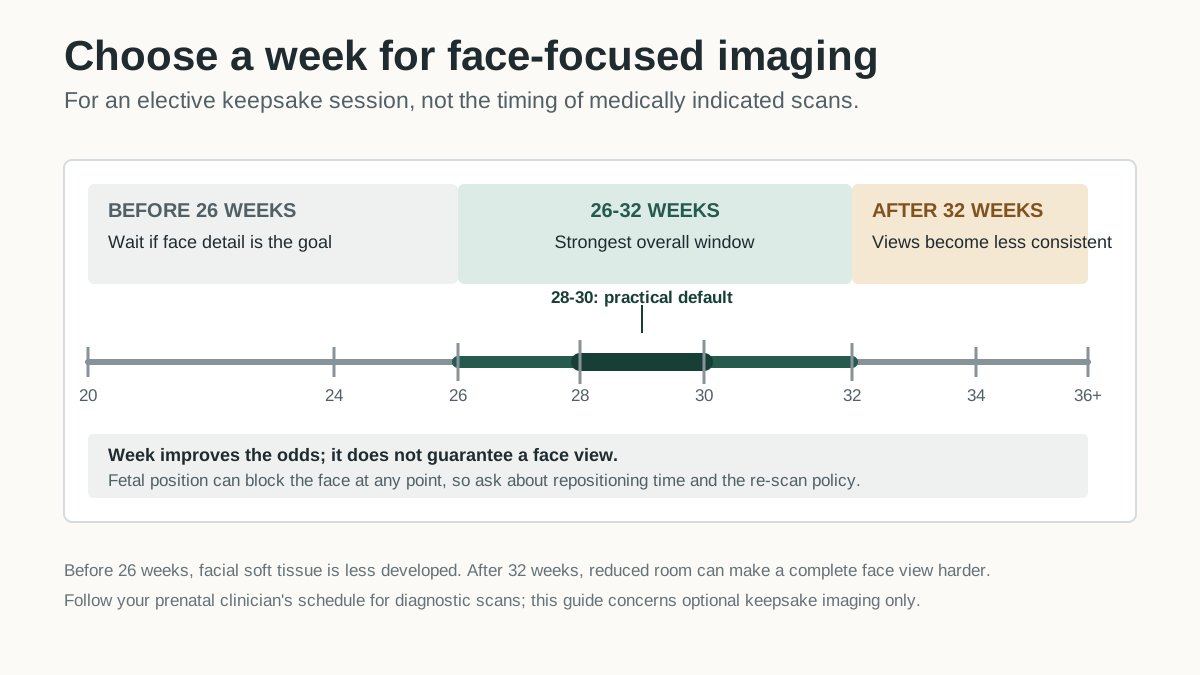
For an optional face-focused 3D/4D session, book between 26 and 32 weeks, with 28–32 as the peak. That window is the biggest single lever for face clarity, bigger than scan type, studio brand or package tier. Earlier, the face lacks soft-tissue definition; later, space runs out and partial views become common.
This timing is for an optional face-focused keepsake session, not for medically indicated scans. Follow your prenatal clinician's schedule for diagnostic imaging.
This guide gives the week-by-week breakdown once, explains why the window works, and shows what can be recovered from your scan if you already booked too early or too late.
For the 3D-vs-4D choice itself, see the scan type comparison. For what a scan can and cannot reveal about your baby's face, see what ultrasound facial contours really show.
Week-by-Week: Ultrasound Face Clarity
Start with the scheduling decision, then use the table for the more granular trade-offs inside and outside the recommended window.
| Gestational window | Typical face clarity | What you see / recommendation |
|---|---|---|
| 12–16 weeks | Low | Skeletal outline, little facial fat; too early for a face keepsake |
| 20–24 weeks | Low to medium | Profile and skull contour visible; face detail inconsistent |
| 26–28 weeks | High | Soft tissue fills in; an excellent start of the window |
| 28–32 weeks | Very high | Peak balance of definition, fluid and room to move; the best target |
| 32–36 weeks | Medium to high | Still good, but quality depends heavily on fetal position |
| 36+ weeks | Low to medium | Tight quarters; partial views common, still worth trying |
The same window applies to 3D and 4D alike, because both depend on the same tissue development and fluid conditions. 4D is slightly more forgiving in borderline weeks because motion gives more frame opportunities, but it does not shift the window.
Reading the table for your week
- Before 24 weeks. The scan is medically useful, but as a face keepsake it will read skeletal, because there isn't enough facial fat yet. If a face image is the goal and your schedule allows, waiting 2–4 weeks buys more clarity than any package upgrade.
- Inside the window (26–32). Book with confidence at any point here. Within the band, earlier gives more room for movement, later gives fuller features; 28–30 is the pragmatic default if you want one number.
- 32–36 weeks. Results hinge on position at session time. Process is what protects you here: an operator willing to pause for movement, and a clear re-scan policy in case the face stays buried.
- 36+ weeks. Go in expecting partial views. A cheek-and-profile frame is a normal outcome rather than a failed session, and landmarks captured here are still usable for AI enhancement.
What about 2D scans from routine visits?
Your standard prenatal 2D images are profile slices rather than surface renderings: beautiful for medical purposes, weak as face previews. If a 2D printout is all you have, a face-forward profile frame can still carry some structure, but a 3D/4D frame from the window above is a far stronger source. The scan type guide covers the difference in depth.
Why Weeks 26–32 Work Best
The recommendation comes from anatomy and physics, not studio convention:
- Facial soft tissue. Cheeks, lips and chin fill out through the late second and early third trimester. Before that, the rendering reads skeletal.
- Amniotic fluid as an acoustic window. Fluid between the probe and the face is what lets sound waves define soft-tissue contours cleanly.
- Room to move. Before the final weeks, most babies can still rotate, giving the operator chances to catch a face-forward angle.
- Probability, not certainty. Even in the perfect week, position can block the view. Timing raises the odds; it cannot guarantee the shot.
Operator skill and equipment are the second and third levers; a patient sonographer in the right week beats a premium package in the wrong one. This ranking is also why "guaranteed perfect face view" marketing should read as a red flag: the two biggest factors, week and position, are only partly (timing) or not at all (position) under the studio's control. What a good studio can guarantee is process: enough scanning time, reposition attempts, and a re-scan if the face never shows.
Timing by Goal
| Primary goal | Best timing target | Why |
|---|---|---|
| Clearest face keepsake | 28–32 weeks | Best overall reliability |
| Budget-efficient result | 26–30 weeks | High quality, less need for a rebook |
| Emotional movement session (4D) | 28–31 weeks | Best chance of expressive captures |
| Source image for AI enhancement | 26–32 weeks | Stronger structure in, better photo out |
| Last chance before due date | 32–36+ weeks | Possible, less consistent; see below |
Three concrete examples of using the table: for simple keepsake stills, schedule 3D around week 28; for an interactive family session, book 4D between weeks 28 and 31 with extra time; for an upload-ready AI source, any clean face-forward capture inside 26–32 works, because the AI cares about visible structure rather than which package produced it.
7 Practical Tips for a Better Scan
- Book by week, not by calendar convenience. Target the window above.
- Ask about effective scan time, meaning actual imaging minutes rather than appointment length.
- Follow your provider's hydration guidance. Fluid conditions affect image quality.
- Don't judge the session by one frame. Review multiple captures.
- Choose an experienced sonographer. Technique matters as much as the machine.
- Ask about the re-scan policy before paying. It protects you from a bad-position day.
- Keep the best raw digital still. Styled prints are nice; the raw frame is what AI enhancement and comparisons need.
On the day itself, two low-effort habits help: arrive normally hydrated (fluid conditions build over days rather than minutes, so follow whatever guidance your provider gave), and build in slack after the appointment so a 15-minute "walk around and come back" retry is possible if the baby is facing away. Sessions fail on rigidity more often than on equipment.
Booked Too Early or Too Late? What AI Can Recover From Your Scan
Missing the window does not mean the scan is worthless. It means less of the face was captured, and the question becomes what can be reconstructed from what's there.
- Early scan (before ~26 weeks). The geometry that is visible (head shape, profile, nose bridge) is real and usable. The AI renders a plausible face from it, with more estimation in the cheeks and lips, which haven't filled out yet. If you can wait 2–4 weeks for another session, the source will be stronger.
- Late scan (33+ weeks). Usually the opposite problem: great facial fullness, partial view. If at least the nose–lips–chin triangle is visible in one frame, that is enough structure for a meaningful portrait; a fully hidden face is not recoverable, and no tool can invent it.
- Blurry or shadow-heavy frame from the right window. Often the best case for enhancement: the structure is in the data, just noisy, and rendering cleans it up.
If you are choosing which frame to upload, face-forward beats profile, uncovered beats hand-near-face, and a raw digital still beats a phone photo of a printed image, though a well-lit photo of a printout works too. One frame where the nose, lips and chin are all visible outperforms five frames that each show two of the three.
AI amplifies what your scan recorded; it does not create anatomy from nothing. Before paying a studio for a rebook, you can turn a clear ultrasound scan into a baby picture to see whether the frame has enough visible structure for a portrait.
FAQ
When is the best time to do a 4D ultrasound?
Most parents get the strongest face-focused results between 26 and 32 weeks. If you want one number, aim for 28–30: enough soft tissue for a defined face, still enough room for the baby to turn toward the probe.
When can you get a 3D ultrasound for face detail?
You can get 3D at many stages, but clear face detail is most consistent around 26 to 32 weeks.
Is 28 weeks too late for 4D ultrasound?
No. Week 28 is usually inside the strongest timing range for clear facial detail.
Is a 32 week ultrasound still good?
Yes, a 32 week scan can still be very good, though image quality becomes more dependent on fetal position and space.
Can I still get useful images after 36 weeks?
You can still try, but partial views are more common. If enough landmarks are visible, AI enhancement may still help.
How many keepsake ultrasounds should I schedule?
Most families target one well-timed session in the ideal window. Extra sessions are optional and depend on budget and goals.
Does 4D have a different ideal week than 3D?
Not significantly. Both read the same anatomy, so the ideal weeks match. The practical difference is session planning: 4D benefits from a longer appointment, because you are waiting for movement rather than one good still.
What should I do if my scan is not clear?
Check position and timing factors and ask about re-scan options first. Then use your best frame for AI enhancement if enough facial landmarks are visible.
Trusted References
- ACOG: Ultrasound Exams
- Mayo Clinic: Fetal Development by Week
- What to Expect: Pregnancy Week-by-Week
- MedlinePlus: Prenatal Care
Ready to Use Your Current Scan?
Even if your ultrasound is not perfect, you can still try a preview.
Upload your ultrasound and see your baby's face
For entertainment and visualization only. Not medical advice and not a medical diagnosis.