3D vs 4D Ultrasound: Which Shows Baby's Face Better? (And What "5D" Really Means)
Choosing between 3D and 4D ultrasound is simpler than studio menus make it look. 3D gives you a still image of your baby's face; 4D gives you the same image in real-time motion, which mostly buys you more chances to catch a clear angle. Everything else, including "5D", "HD Live" and premium packages, is rendering style layered on top of the same scan.
This guide compares the two for face detail, cost and timing, decodes the 5D/HD Live labels, and ends with a straight recommendation. If your main question is resemblance, meaning whether the baby will look like the scan, see what ultrasound facial contours can and cannot show.
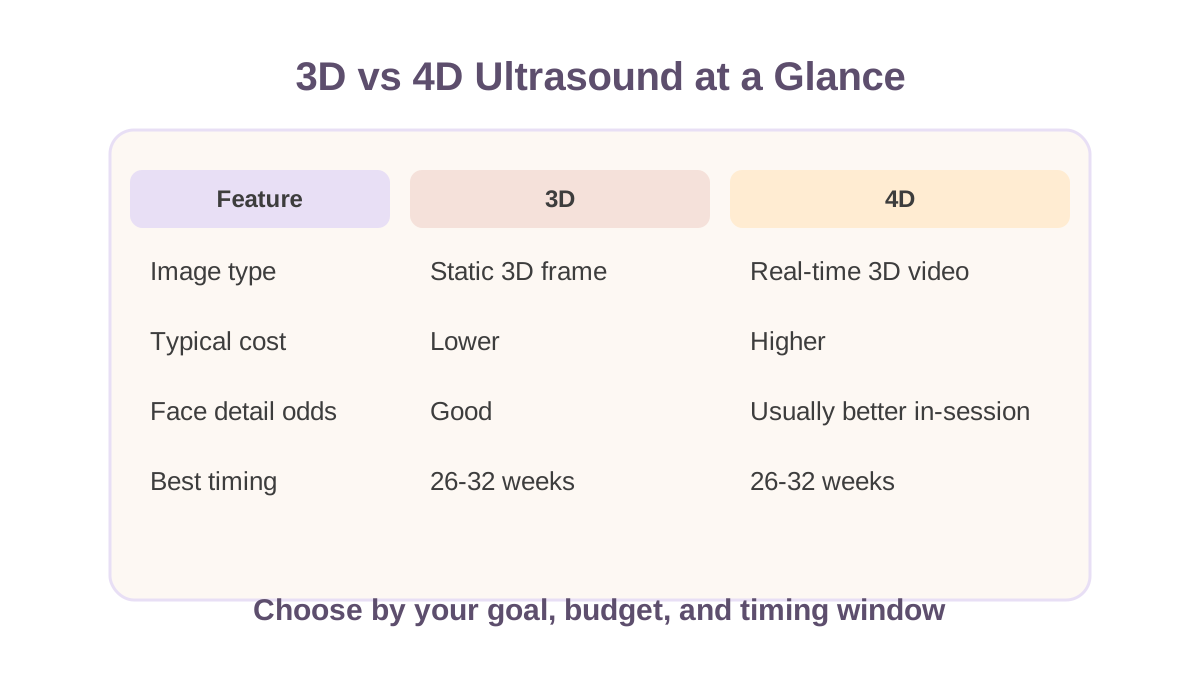
Quick Answer: 3D vs 4D at a Glance
If your only goal is a still facial image at lower cost, 3D is usually enough. If you want movement, a more emotional session, and better odds of a clean face frame in one appointment, 4D is the better choice.
| Feature | 3D Ultrasound | 4D Ultrasound | What it means for you |
|---|---|---|---|
| Image format | Static 3D still image | Real-time 3D video | 4D gives movement context |
| Face detail | Good | Usually better in practice | Motion can reveal better angles |
| Session feel | Snapshot-focused | Interactive and emotional | Many parents prefer the 4D experience |
| Typical elective price (US) | Lower | Higher | Budget often drives this choice |
| Best gestational window | 26–32 weeks | 26–32 weeks | Same for both; see the timing guide |
| AI enhancement compatibility | Good | Good | Any clean scan can be enhanced |
How 3D and 4D Ultrasound Work (Briefly)
Both use the same principle as every prenatal ultrasound: a transducer sends high-frequency sound waves, software reconstructs the reflections into a volumetric image. 3D renders one still volume; 4D re-renders it many times per second, producing live motion. There is no radiation involved, and the safety picture is the same for both; we cover the FDA, ACOG and WHO positions in detail in Is 3D/4D ultrasound safe?
What that difference means in the room:
- 3D strengths: lower cost, strong structural stills (nose profile, lip shape, chin line), widely available.
- 3D limits: one angle per capture, so if the face is turned away or hand-covered you have fewer chances to recover the view.
- 4D strengths: you watch the baby yawn, swallow and shift; the operator can wait for a clean frame instead of hoping the first one lands.
- 4D limits: higher price, and quality still depends on timing, fluid and position, since motion does not fix a face pressed into the placenta.
2D vs 3D vs 4D vs 5D vs HD Live: What Each Label Means
Studio menus mix imaging technology with rendering marketing. This table separates them:
| Label | What it actually is | Technology or marketing? | What you get |
|---|---|---|---|
| 2D | Standard flat cross-section imaging | Technology | The black-and-white medical scan; basis of all diagnostics |
| 3D | Volumetric reconstruction of 2D slices | Technology | A still, sculpture-like view of the face |
| 4D | 3D re-rendered in real time | Technology | Live motion: yawns, swallows, expressions |
| HD Live | Advanced lighting/skin rendering on 3D/4D data | Rendering style | More photorealistic stills, with a virtual light source and softer skin tones |
| "5D" | Studio branding for HD Live-class rendering | Marketing | Same acquisition as 3D/4D with premium rendering and packaging |
Is 5D ultrasound a real upgrade?
"5D ultrasound" is a label studios attach to HD Live-style rendering packages rather than a fifth dimension or a new scanner class. That doesn't make it worthless: the renderings do look smoother and more skin-like. But the source data is the same 3D/4D acquisition, so a "5D" session with poor timing or a turned-away baby produces a worse image than a plain 3D session in the right week.
Before paying a 5D premium, ask two questions:
- Is the machine and sonographer experience actually better, or only the rendering preset?
- Would that money be better spent on a well-timed session with a clear re-scan policy?
If the goal is a realistic face image, capture quality beats rendering labels every time. Rendering can be improved after the fact; missing anatomy cannot.
What premium "5D"/HD Live packages typically bundle, so you know what you are comparing: longer session time (often the valuable part), the rendering preset, more digital stills or clips, sometimes prints or a heartbeat toy. Price the bundle against its parts. Extra scanning minutes and a re-scan guarantee are worth real money; a rendering preset on its own is not.
HD Live vs 4D in practice
HD Live-style rendering adds a virtual light source and softer skin tones to the same volume data. On a clean capture it looks noticeably more lifelike; on a poor capture it produces a smoother version of the same unclear face. Rendering multiplies source quality and never substitutes for it.
What about "8K ultrasound"?
Same category, one rung further. There is no 8K scanner; the label covers upscaled re-renders of an ordinary 3D/4D capture, and sometimes outright AI-generated portraits. Our guide to 8K ultrasound images shows how that kind of portrait is made from an existing scan and what the result can and cannot reveal. If you are specifically wondering whether any package can show your baby's hair, see can you see hair on a 3D ultrasound.
Two related questions parents bring to these packages, answered elsewhere on the site: why the nose looks so big on a 3D scan (rendering, not genetics), and how much the scan resembles the born baby overall.
Which Type Shows Baby's Face Most Clearly?
Depends on what "clearly" means to you:
| Your definition of "clear" | Winner | Why |
|---|---|---|
| Best still structure for the money | 3D | A good 3D still matches a 4D still capture |
| Best odds in one appointment | 4D | Motion = more frames = more chances of a clean angle |
| Most emotional, readable session | 4D | Movement gives context stills can't |
| Best value on a tight budget | 3D | Lower price, still strong facial detail |
| Clinical/diagnostic question | Neither; follow your OB-GYN | Medical intent comes first |
Neither mode guarantees a clear face frame. Image quality depends on timing, position, fluid and operator skill; the capture mode itself is the smallest of those levers. Ordered by how much they usually affect face clarity:
- Gestational week. The dominant factor; the 26–32 window beats any equipment upgrade.
- Fetal and placenta position. A face pressed into the uterine wall defeats every scan type equally.
- Amniotic fluid. The acoustic window that defines soft-tissue contours.
- Operator patience and technique. Angle decisions and willingness to wait for movement.
- 3D vs 4D vs rendering label. Changes the output and session workflow, but cannot overcome a poor acoustic window.
That ranking is the practical decision rule: choose 4D for motion and more chances to select a usable frame, not because it guarantees a sharper face. Choose 3D when one well-timed still is enough.
Cost Comparison: 3D vs 4D Ultrasound in the US (as of 2026)
Elective keepsake studios charge out of pocket; diagnostic scans ordered by your provider may be covered by insurance. Typical elective ranges as of mid-2026:
| Package type | Typical US range | Notes |
|---|---|---|
| Basic 3D keepsake session | $100–$180 | Usually includes still images |
| Standard 4D keepsake session | $140–$260 | Live viewing plus clips in many studios |
| Premium "HD/5D" branded package | $180–$350+ | Longer sessions, bundled extras, premium rendering |
| Add-on digital files/prints | $15–$80 | Varies by studio |
These are broad market ranges, not fixed prices; metro markets run higher. What moves the price most: session length, studio brand, included media, re-scan policy and equipment generation.
Two economic points worth separating:
- Insurance almost never applies to elective keepsake sessions. Coverage follows medical indication. If your provider orders a scan for clinical reasons, that's a different billing universe from a studio package, even on similar machines.
- The most expensive outcome is a cheap session in the wrong week. A $100 scan at 22 weeks that shows a skeletal face usually leads to a second booking anyway; one well-timed $180 session is cheaper than two mistimed ones.
A cost-efficient default: one strong 3D/4D session in the right week, at a studio with a clear re-scan policy, then use your best frame to convert a 3D ultrasound into a realistic baby image instead of paying for premium add-ons.
Best Timing for 3D vs 4D Ultrasound
Timing matters more than scan type: a great machine in the wrong week loses to an average machine in the right one. The practical sweet spot for face clarity is the same for both types, roughly weeks 26–32. The full week-by-week breakdown, including what to do if you are earlier or later, lives in the best-time guide.
Which Should You Pick? Final Recommendation
- Choose 3D if your priority is lower cost and a solid still image.
- Choose 4D if you want movement, the session experience, and better odds of a clear face angle in one visit.
- Skip the "5D" premium unless the studio can show it means better equipment and operators, not just a rendering preset.
- Either works for AI enhancement. What matters is a clean, face-forward source frame.
If you are undecided, the highest-value path is: book at 28–30 weeks, pick a provider with a transparent re-scan policy, start with 4D if budget allows, and keep your best raw frame.
How that plays out in the three most common situations:
- "We want one affordable keepsake photo." A good 3D session around 28–30 weeks, with a quick image review before you leave so you know at least one strong face frame exists.
- "We want the session to be the experience." 4D with an experienced sonographer and enough booked time for the baby to shift naturally. The movement is the product here; stills are a byproduct.
- "Our first scan came out unclear." Diagnose before rebooking: was it timing, position, fluid or session length? If the frame has visible structure and only looks noisy, AI enhancement on the existing scan may already give you the face; if the face was fully hidden, a re-scan is the only fix.
Three questions worth asking any studio before you pay: how much effective scanning time is included (not check-in time), what happens if the face is not visible, and whether you get raw digital stills rather than only styled prints. A provider that answers all three plainly is worth more than any package label; one that promises a "guaranteed perfect face view" is overpromising something no operator controls.
Can AI Improve 3D and 4D Ultrasound Results?
The same AI workflow can accept a still exported from either type. It uses visible facial cues as inputs and estimates the missing surface layer, including skin, hair, eye state and lighting. A frame with visible structure gives the model more to work from; a face fully hidden behind a hand does not.
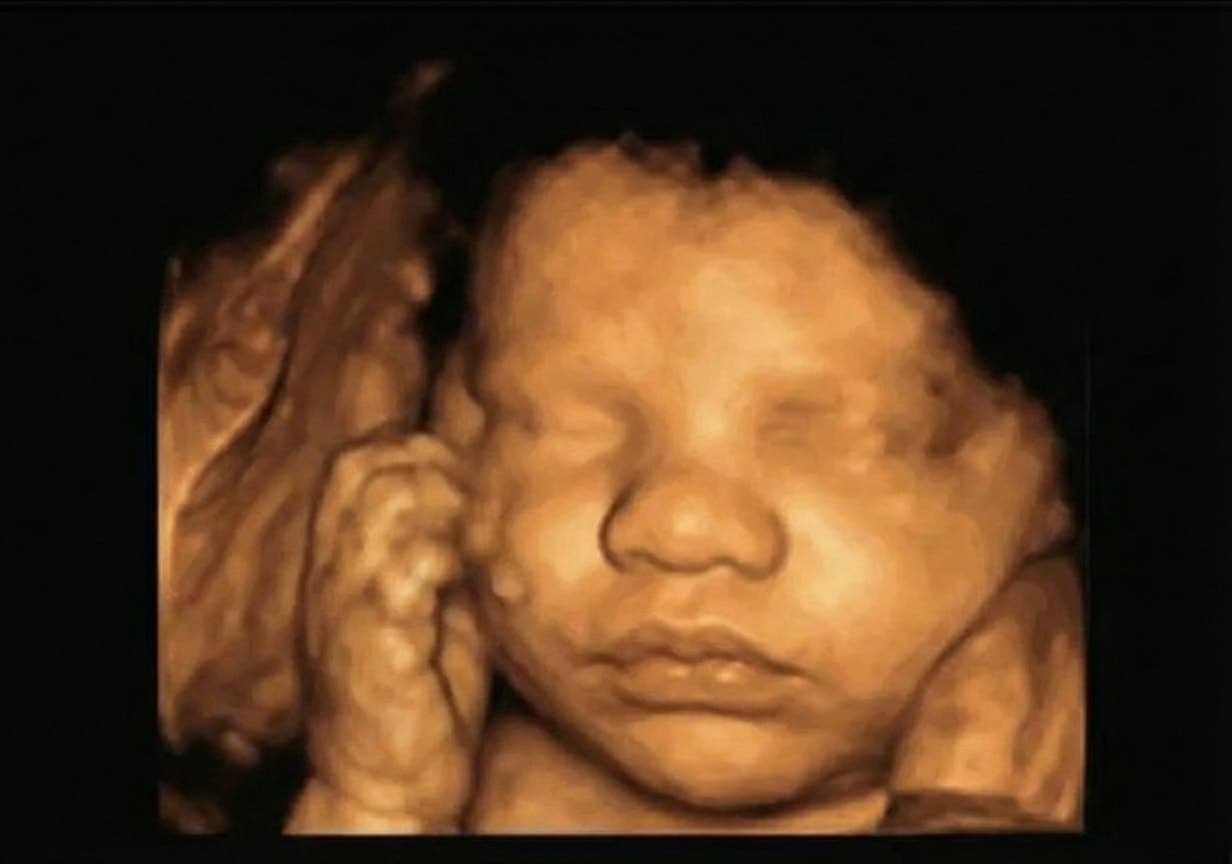 4D scan · 32 weeks
 AI photo from this scan
An AI result is not a post-birth comparison or a promise of exact resemblance. If you already have a scan, upload it.
FAQ
Is 4D ultrasound worth the extra cost?
For many parents, yes: 4D adds real-time movement and improves the odds of catching a clear face angle in one session. If budget is the constraint, a well-timed 3D still is often enough.
What is 5D ultrasound?
"5D" is a marketing label, not a new imaging technology. It usually means enhanced rendering (HD Live-style lighting and skin tones) applied on top of the same 3D/4D acquisition.
Is 3D/4D ultrasound safe?
Ultrasound uses sound waves, not ionizing radiation. FDA, ACOG and WHO consider diagnostic use safe when performed by trained providers; see our detailed safety guide for their exact positions.
Can I get a 3D ultrasound at any pregnancy stage?
You can, but face clarity is usually best between 26 and 32 weeks.
What if my baby's face is hidden during the scan?
Ask about reposition attempts or the re-scan policy. Even partial captures can sometimes be improved with AI enhancement.
Can AI work with both 3D and 4D scans?
Yes. AI can work with either if your source image has enough visible facial structure.
External References
- American College of Obstetricians and Gynecologists (ACOG): Ultrasound Exams
- FDA: Ultrasound Imaging
- Mayo Clinic: Fetal Ultrasound
- What to Expect: Pregnancy Ultrasound Guide
Ready to See Your Baby Preview?
Already have a scan? Our AI turns it into realistic portraits of your baby, ready in minutes.
Upload your ultrasound and start now
For entertainment and visualization purposes only. Not medical advice and not a diagnostic tool.