Can You See Hair on a 3D Ultrasound?
Sort of, and later than most parents expect. Hair may show up as bright linear echoes extending from the scalp into the surrounding fluid, usually late in pregnancy, but the scan carries no information about its color or texture. What you're seeing is an acoustic pattern rather than a photograph of individual strands. It cannot tell you whether your baby is blonde, dark-haired, curly or straight.
This guide covers what hair looks like on 2D vs 3D scans, which weeks it becomes visible, the difference between lanugo and scalp hair, and what "8K ultrasound" packages are selling you.
What Hair Looks Like on an Ultrasound
Hair is a hard target for ultrasound. Readers do not count individual strands: they look for a consistent pattern of echoes arising from the scalp across live frames. A single spiky 3D render is not enough, because surface rendering can turn the same signal, or an artifact, into ridges and contours.
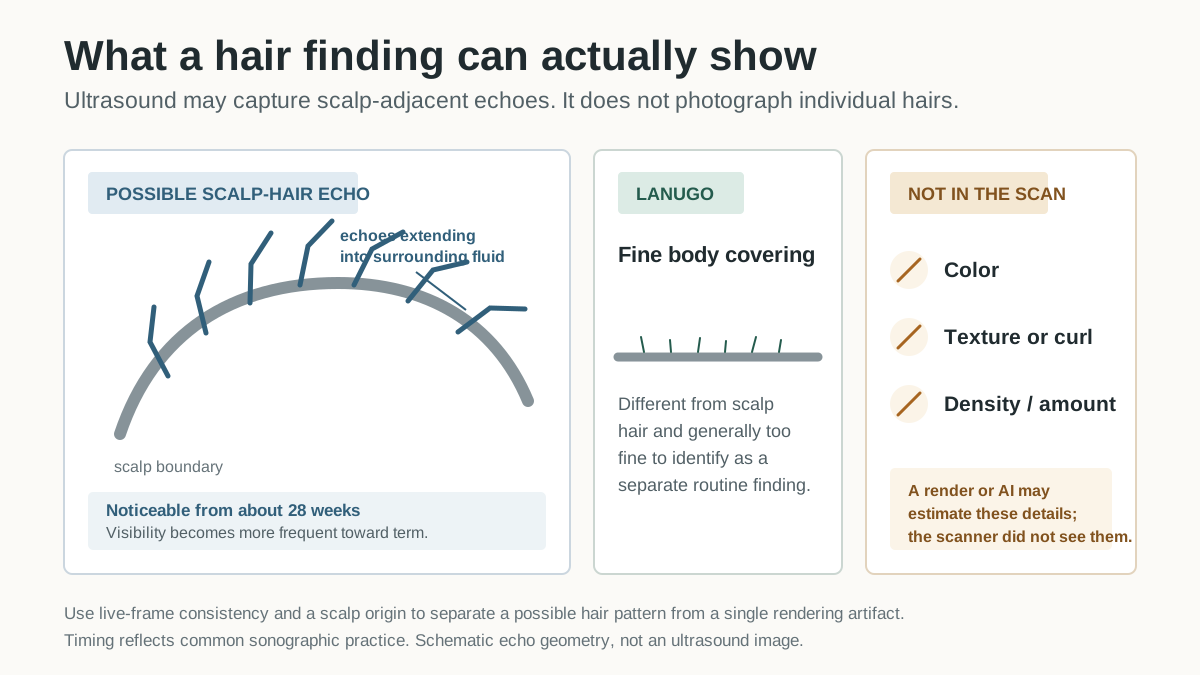
The most important limit is that the scan renders shape rather than surface. Color, thickness, and texture are not in the data. If a scan appears to show light or dark hair, you're looking at the machine's rendering palette and gain settings, the same orange-gold tint that makes every 3D baby the same color.
What Week Can You See Hair on a Scan?
Two different things are called "baby hair," and they show up at different times, which is why the week answers you find online contradict each other.
| What it is | When it develops | When it's typically visible on a scan |
|---|---|---|
| Lanugo (fine, downy body hair) | Roughly 16–20 weeks | Rarely picked out on a scan; usually too fine to resolve |
| Scalp hair | Follicles form in the second trimester; hair lengthens through the third | Most commonly noted from about 28 weeks, with visibility increasing toward term |
Lanugo is the soft, feathery hair that covers the fetal body from around 16–20 weeks. Its job is practical: it helps the vernix stick to the skin and supports temperature regulation, and it mostly sheds in the last weeks before birth. It is not the hair on the newborn's head, and it's usually too fine for ultrasound to separate from the skin surface.
Scalp hair is the one you can sometimes see. Sonographers and elective studios most often point out scalp hair from around 28 weeks, with detection becoming more frequent toward term. In practice, parents are most likely to have it pointed out during a later scan, including the same broad window that often gives clear face images (weeks 26–32).
One caveat about absence: a scan showing no hair does not mean a bald baby. Fine hair can be missed; a scalp pressed against the uterine wall may not show a useful boundary; a slightly different angle can lose the whole effect. Plenty of babies who showed a smooth scalp late in pregnancy arrive with a full head of hair.
Can the Scan Tell You Hair Color or How Much?
No, on both counts, and it's worth being specific about why, because this is the most common misunderstanding about keepsake scans.
Color: ultrasound measures how tissue boundaries reflect sound. Pigment has no acoustic signature at all. There is no setting, no machine, and no rendering package that can extract hair color from a scan, because the information was never captured.
Amount: the scan is a rough indicator at best. Visible strands do mean some hair, and that part is real. But the absence of visible strands is not evidence of absence, and no one can count what's there. Density estimates from an ultrasound image are guesses.
This is the same line we draw everywhere on this site: structure carries over from a scan, surface does not. Hair sits firmly on the surface side of that boundary, along with skin tone and eye color, which isn't even settled at birth.
The nose is the useful contrast. It's a structure the scan measures, which is why it transfers into a real face even though the scan exaggerates its size. Hair is barely measured and entirely surface, so the same image supports very different levels of confidence depending on which feature you read.
"8K Ultrasound": What the Marketing Actually Means
If you've been shopping for elective scans, you've seen packages branded "8K", and you're probably wondering whether 8K would finally show you your baby's hair.
There is no 8K ultrasound scanner. No clinical machine acquires at 8K resolution, and ultrasound's resolution is capped by physics (sound wavelength and tissue penetration) rather than pixel counts. "8K" is not a scanner class the way 3D and 4D describe genuinely different acquisitions.
What studios sell under that label falls into two buckets:
- Upscaling and enhanced rendering. Your existing 3D/4D capture is enlarged and re-rendered with smoother lighting and skin tones. This is the same family as "5D" and HD Live: a rendering preset applied on top of the scan you already had. It can look nicer, and it adds no new information.
- AI-generated portraits. Several "8K" packages are, in practice, an AI reconstruction of what your baby might look like, with skin tone, eyelashes, and hair filled in by a model, often using details you supply about the parents. An AI-generated 8K ultrasound portrait is a legitimate keepsake, but it is not imaging and should not be sold as if the scanner saw those details.
So can 8K show you hair the scan didn't capture? It can draw hair, but it can't reveal any, because there's nothing extra in the file. Before paying an 8K premium, the useful question is which bucket you're buying: extra session minutes and a re-scan guarantee are worth real money, and a rendering preset on its own is not.
Which Parts of Our Preview Come From Your Scan
We'll hold ourselves to the same standard we just applied to 8K packages.
Our AI reads the facial structure that's in your scan (nose, lips, chin, cheeks, face shape) and keeps that geometry. Hair is an estimate rather than scan data. When the portrait shows your baby with hair, the model is rendering a plausible newborn head rather than reporting something the ultrasound measured. The same is true of skin tone and eye color.
We say this plainly because the alternative is a promise nobody can keep. If a service tells you it can show your baby's real hair color from an ultrasound, that claim is not physically possible, regardless of what the package is called.
What you do get is a realistic face built on the structure your scan contains, ready in minutes. You can create an AI baby photo from your ultrasound and see the difference between the parts that carry over and the parts we're estimating.
FAQ
Can you see hair on a 3D ultrasound?
Sometimes. Hair may appear as bright linear echoes extending from the scalp into surrounding fluid. It is most often noticeable from about 28 weeks and is seen more frequently toward term. A 3D render may turn those echoes into surface contours, but color and texture are never visible.
At what week can you see hair on an ultrasound?
It is most often noticeable from about 28 weeks, with detection becoming more frequent toward term. Lanugo, the fine downy body hair, develops around 16–20 weeks but is usually too fine to identify separately on a routine scan, and it mostly sheds before birth.
Can an ultrasound tell you your baby's hair color?
No. Ultrasound measures how tissue reflects sound waves, and pigment has no acoustic signature. No machine or rendering package can extract hair color from a scan, so any color you see in a preview is an estimate or a rendering palette.
My scan showed no hair. Will my baby be bald?
Not necessarily. Fine hair can be missed, a scalp pressed against the uterine wall may not show a useful boundary, and a slight angle change can lose the effect entirely. Absence of visible hair on a scan is not evidence of absence.
Is 8K ultrasound real?
Not as a scanner. No ultrasound machine acquires at 8K, and resolution is limited by physics rather than pixels. "8K" packages are either upscaled/re-rendered versions of your existing 3D/4D capture, or AI-generated portraits, and both work from the scan you already have.
Trusted Medical Sources and Further Reading
- Cleveland Clinic: Lanugo
- Petrikovsky et al.: Sonographic appearance of occipital fetal hair
- ACOG: Ultrasound Exams
- Mayo Clinic: Fetal Ultrasound
For entertainment purposes only. Not medical advice and not a medical diagnosis.