When Do Babies' Eyes Change Color?
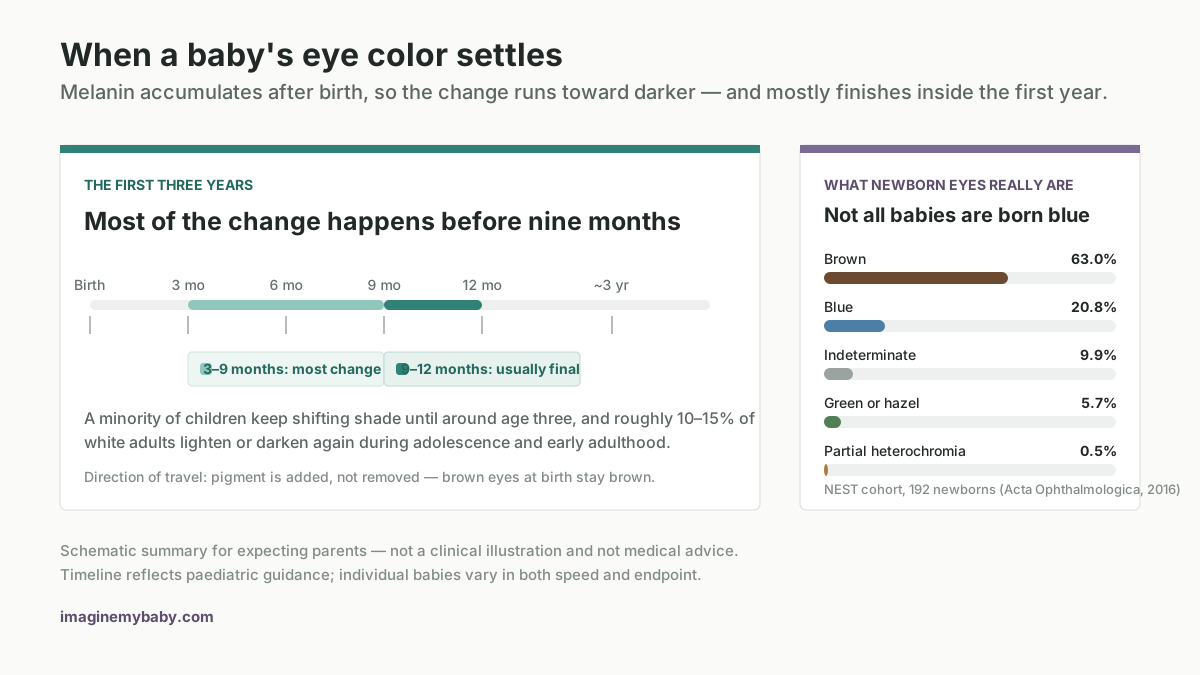
Most babies' eyes change color between 3 and 9 months, and the final color is usually settled somewhere between 9 and 12 months. A minority of children keep shifting shade until around age three. The change almost always runs one way, toward more pigment and therefore darker, because melanin accumulates in the iris after birth and does not un-accumulate.
The longer answer starts with the fact that the premise behind the question is usually wrong: most babies are not born with blue eyes at all.
When Do Babies' Eyes Change Color? The Month-by-Month Timeline
There is no single switch-flip date, but the pattern is consistent enough to plan around.
| Age | What's usually happening |
|---|---|
| Birth – 6 weeks | Whatever color you see is the starting point. Very little has changed yet. |
| 6 weeks – 3 months | Pigment production ramps up. Dark-blue or slate eyes may start to look murky or flecked. |
| 3 – 6 months | The most visible stretch. Blue can turn green, hazel or brown, often quickly enough to notice between photos. |
| 6 – 9 months | Change slows. What you see here is close to what you'll keep. |
| 9 – 12 months | Usually final. The American Academy of Pediatrics puts it plainly: melanocytes take about a year to finish their work, so calling eye color before the first birthday is a dicey business. |
| 1 – 3 years | Occasional late shifts, almost always a deepening rather than a new color. |
If your baby is four months old and the eyes look different in every photo, that's the normal middle of this curve, not an anomaly. If they're eleven months old and still blue, they are very likely to stay light.
Are All Babies Born With Blue Eyes?
No, and this myth is worth killing properly, because it's the reason so many parents expect a change that was never coming.
Researchers at Stanford actually counted. The Newborn Eye Screening Test (NEST) study photographed the irides of 192 healthy full-term newborns and reported the birth prevalence directly (Ludwig et al., *Acta Ophthalmologica*, 2016):
- 63.0% brown
- 20.8% blue
- 9.9% indeterminate
- 5.7% green or hazel
- 0.5% partial heterochromia
So brown-eyed newborns outnumbered blue-eyed ones three to one. The myth survives because it's true for a specific slice of the population: babies of predominantly Northern European ancestry, where the light-eye variants are common. That slice has historically been over-represented in the pictures we all grew up seeing.
The practical consequence: if your baby was born with brown eyes, they will almost certainly stay brown. Pigment gets added over the first year, never removed. A brown iris has already made the melanin; there is no mechanism to take it back out.
Why Baby Eye Color Changes at All: Melanin and Light
Eye color is one pigment doing all the work. Melanin, produced by melanocytes in the front layer of the iris, absorbs light: plenty of it reads as brown, a little as green or hazel, almost none as blue. There is no blue pigment in a human iris: blue eyes are a structural effect, light scattering in a low-pigment layer, the same physics that makes the sky blue.
A fetus develops in the dark. The usual explanation, as Cleveland Clinic describes it, is that light exposure after birth prompts those melanocytes to start producing pigment in earnest, which is why the change begins in the first months of life rather than before birth. How much pigment they eventually make is set by genetics; the timing is what the outside world contributes.
This is also why the change is directional. Melanin accumulates. A baby can go from blue to green to hazel to brown over a year, and plenty do. Going the other way, brown at birth and blue at one, essentially doesn't happen.
Starting Color → Likely Final Color
Treat this as direction of travel rather than prophecy. The stronger the pigment already visible, the less room there is to move.
| What you see in the first weeks | What usually happens next | Roughly settled by |
|---|---|---|
| Brown | Stays brown; may deepen a shade | 6 months |
| Dark blue or slate grey | The most changeable start; may go green, hazel or brown | 6–12 months |
| Clear light blue | Often stays light, especially if both parents are light-eyed | 9–12 months |
| Green or hazel (uncommon at birth) | Usually deepens slightly, stays in the same family | ~12 months |
| Two different colors (heterochromia) | Usually stable and harmless, but worth mentioning at a check-up | — |
A useful checkpoint: compare photos taken in the same light at 3 months and 9 months. Iris color is notoriously sensitive to lighting, clothing color and camera white balance, and half the "my baby's eyes changed overnight" moments are a different lamp.
What Actually Decides the Final Color
Genetics, mostly, and not one gene. The blue-versus-brown axis is dominated by the OCA2 and HERC2 genes on chromosome 15, where a single variant does most of the heavy lifting, but more than a dozen additional genes fine-tune the outcome. That's why full siblings with the same parents land on different shades, and why green and hazel are so much harder to predict than the two extremes.
Which is why the answer to "what color will my baby's eyes be?" is a set of probabilities rather than a color. Our baby eye color calculator takes both parents' eye colors, plus the grandparents' where you know them, and gives you the odds of brown, hazel, green and blue, with the reasoning shown. It will not tell you a color, because nothing can.
One myth to retire while you're there: two brown-eyed parents can absolutely have a blue-eyed baby. Brown needs only one pigment-producing copy, so a brown-eyed parent can carry a light variant they never display.
When Eye Color Change Isn't Just Development
Almost all of this is ordinary. Two situations are worth a mention to your pediatrician rather than a search engine:
- Two different-colored irides (heterochromia) in a newborn. It was seen in 0.5% of the NEST babies and is usually benign and inherited, but it is occasionally associated with conditions worth ruling out, so flag it at a check-up.
- A sudden change in one eye, or a change accompanied by redness, cloudiness, a white pupil in flash photos, or anything that looks like discomfort. Gradual, symmetrical darkening over months is development. Abrupt or one-sided change is not, and should be looked at promptly.
This article is general information for expecting and new parents, not medical advice. Anything that worries you about your baby's eyes belongs with your pediatrician or an ophthalmologist.
Why a Scan Can't Show Eye Color
We build AI baby photos from ultrasound scans, so we get asked whether a scan can show eye color. It cannot, and the reason is worth stating precisely: ultrasound measures how tissue reflects sound waves, and pigment has no acoustic signature. The information was never captured. No machine, no rendering package and no "8K" upgrade can extract it, any more than a scan can show hair color.
What the scan carries is structure: nose, lips, chin, cheeks, the geometry of the face. That is what our AI works from, and it's why the side-by-side comparisons of scans and real babies match on shape. Eye color and skin tone in a portrait are rendering choices, and we label them as estimates rather than pretending the scan knew.
You can use ultrasound-to-photo AI for a realistic artistic portrait built from the facial structure a scan can actually show.
FAQ
When do babies' eyes stop changing color?
Most babies reach their permanent eye color between 9 and 12 months, after the most visible changes between 3 and 9 months. Some children keep shifting shade until around age three. Beyond childhood it is rare but not unheard of: a long-running twin study estimated that 10–15% of white adults see their eye color lighten or darken during adolescence and early adulthood.
Can a baby's eyes change from brown to blue?
Essentially no. Eye color change in infancy comes from melanin accumulating in the iris, and that process only adds pigment. Brown eyes at birth mean the pigment is already there, so they stay brown. The change runs blue → green → hazel → brown, never the reverse.
Do all babies have blue eyes when they are born?
No. In a study of 192 newborns at Stanford, 63.0% were born with brown eyes and only 20.8% with blue, plus 5.7% green or hazel and 9.9% indeterminate. The "all babies are born blue" idea reflects populations of Northern European ancestry rather than babies in general.
My baby's eyes are grey. Will they be blue or green?
Grey and slate-blue newborn eyes are the most changeable starting point of all, because they signal very little pigment so far and leave the most room to move. They may stay grey-blue, or turn green, hazel or brown over the first year. Six to twelve months usually tells you.
What is the rarest eye color?
Among the common colors, green is the rarest, at around 2% of people worldwide. Grey and amber are rarer still, and true heterochromia rarer again, at about 0.5% of newborns in the NEST cohort.
Can you tell what color a baby's eyes will be at 2 months?
Not reliably. At 2 months the pigment process has barely started, and the most visible changes are still ahead between 3 and 9 months. A brown-eyed 2-month-old will stay brown, but a blue-eyed one is genuinely undecided. Probability is the best anyone can do that early, which is what our eye color calculator gives you.