Why Does My Baby's Nose Look So Big on the 3D Ultrasound?
A nose can look bigger and coarser on a 3D/4D ultrasound than its underlying anatomy, because the image is a surface reconstruction rather than a photograph. Surface smoothing, probe angle and a face pressed against nearby tissue can all change the visible contour. A single rendered frame cannot show how the nose will look after birth.
This guide explains three common sources of distortion and covers why newborn noses can look wide for a while after birth too. If your worry is "will my baby really have this nose," one scan frame cannot tell you. For the full feature-by-feature picture, lips and chin and cheeks included, see our scan vs real baby comparison.
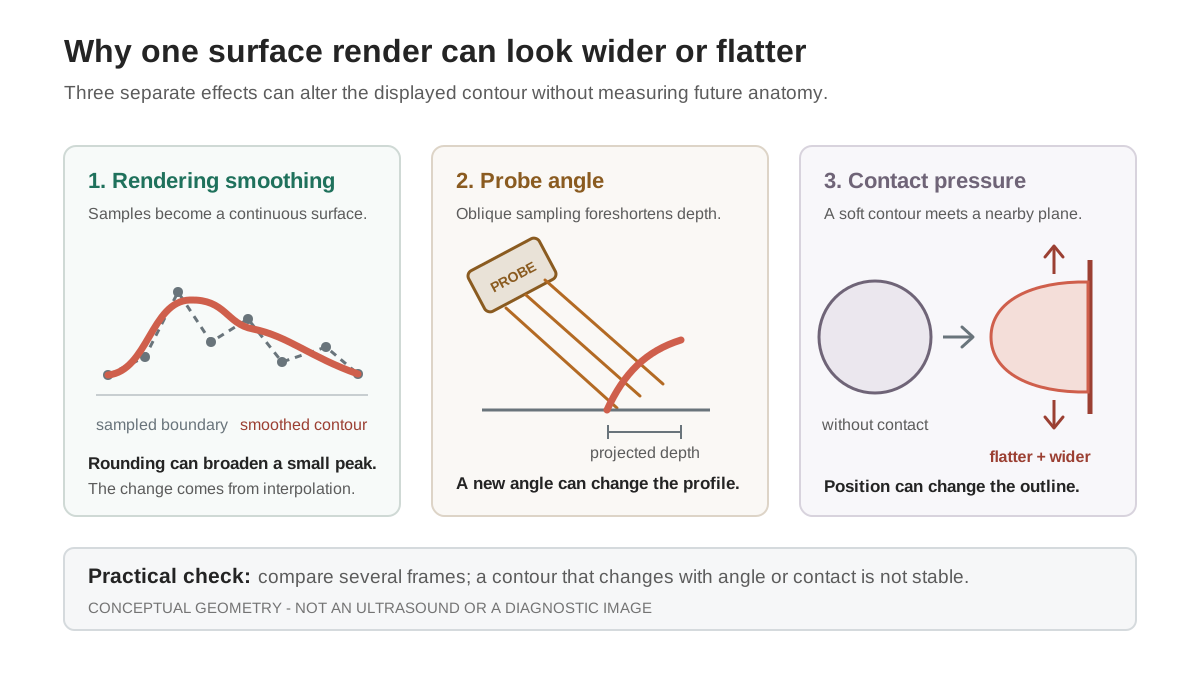
Why the Nose Looks Big on a 3D/4D Ultrasound
A 3D/4D image is not a photograph. It's a computer reconstruction built from reflected sound, and several steps in that pipeline systematically exaggerate the nose:
- Surface rendering rounds uncertain boundaries. To turn echo data into a continuous surface, the machine interpolates between samples and smooths edges. That processing can make a small curved feature look broader or more bulbous than the underlying contour.
- An oblique probe angle causes foreshortening. When a surface is sampled at an angle, its depth is compressed in the projected view and the nearest contour can dominate the render. This is geometry, not photographic perspective, and changing the acquisition angle can change the apparent profile.
- Contact pressure flattens and widens soft tissue. In the third trimester there is less room. If the face rests against the placenta or uterine wall, the visible surface can spread sideways and the tip can look flatter. That contour is positional rather than a stable measurement.
- Low surface resolution adds "gain" and noise. 3D face rendering works at the very edge of what the resolution supports. Speckle noise and the gain (brightness) setting the sonographer dials in can add a grainy, heavier look to the nose and brow that isn't really there.
Stack those four together and you get a nose that looks wide, heavy and a little grumpy on the screen, on a baby who is none of those things.
What's Reliable on the Scan, and What Isn't
Not everything about the nose is noise, but confidence comes from repeated contours across clear frames rather than a single surface render:
| Nose feature | Reliable on the scan? | Why |
|---|---|---|
| Nostril spacing in one render | Limited | Angle, shadow and surface interpolation can change the visible openings |
| Bridge / tip direction | Sometimes | More useful when the same contour repeats across clear angles |
| Apparent width | No | Inflated by soft-tissue smoothing and pressure |
| "Puffiness" / heaviness | No | Rendering artifact plus gain/noise, not anatomy |
The practical rule is to trust repeated contours more than apparent bulk in one frame. A bridge or tip direction that persists across several clear angles is more informative than a nose that merely looks big in one render.
One useful self-check: look at more than one frame from the same session. If the nose changes noticeably between frames where the baby barely moved, you're looking at angle and pressure, not a fixed feature. Trust the most face-forward frame, not the least flattering one.
Do not use an AI-generated portrait as a validation image. A model can add nostril openings, philtrum shape, skin texture and newborn proportions that the scan did not encode. The result may look plausible, but it cannot prove correspondence with the scan or predict the baby's anatomy after birth.
What Actually Smooths Out by Birth (and After)
Even a perfectly accurate scan would be showing you a temporary shape. Newborn noses really are wider and flatter than they'll be later, for reasons that have nothing to do with the scan.
- Birth compression. Passage through the birth canal squashes the whole face; noses are often visibly flat for the first days. This is why the "scan face" frequently reappears in week-two photos rather than delivery-room ones.
- The bridge hasn't developed. A newborn's nasal bridge is mostly cartilage and barely raised. The bony bridge that gives a nose its adult profile fills in over months and years, which is why almost every newborn looks like a button-nose regardless of what they'll grow into.
- Baby fat. Facial fat peaks in infancy and recedes through toddlerhood, slimming the whole nose area.
So there are two separate smoothing effects working in your favor. First, the scan exaggerates the nose beyond reality. Second, the real newborn nose is itself a temporary, softened version of the face to come. The "big newborn nose" parents google at 2am is nearly always an early-days shape.
One timing note, since it changes what you're looking at: the clearest, least-distorted face images come from roughly weeks 26–32. Earlier than that there's little facial fat to render; much later there's so little room that pressure flattening becomes the rule rather than the exception. A worrying nose on a 34-week scan is more likely to be a squashed nose than a big one.
Does the Ultrasound Nose Predict Who the Baby Takes After?
Barely, and only in the loosest way. The scan can hint at a shape family, a fuller tip or a straighter bridge, but it cannot tell you "she has dad's nose." Three reasons:
- The features that make a nose recognizably one parent's (bridge height, adult width, the precise tip) develop after birth, over years.
- The scan's own distortions swamp the subtle differences that resemblance depends on.
- Nose shape is polygenic and doesn't settle until well into childhood.
If you enjoy hunting for family resemblance, compare several clear frames for fun, but treat the result as speculation rather than proof that one feature came from one parent.
How the Preview Handles the Nose
The scan may contain coarse geometric cues, such as a repeated bridge or tip direction, but angle, pressure and image quality can affect even those contours. Fine details such as nostril openings, philtrum shape and skin surface may be absent or ambiguous.
Our AI produces a keepsake interpretation and estimates missing detail from model priors. The output is not a measurement, a correspondence test, a prediction or post-birth verification. A realistic-looking detail in the result does not mean that detail was visible in the scan.
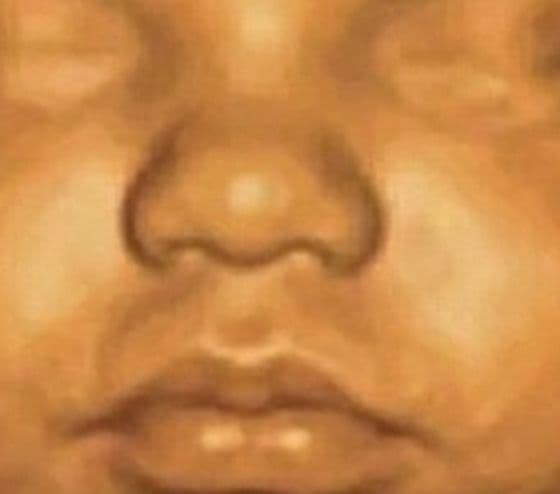 Nose on the scan
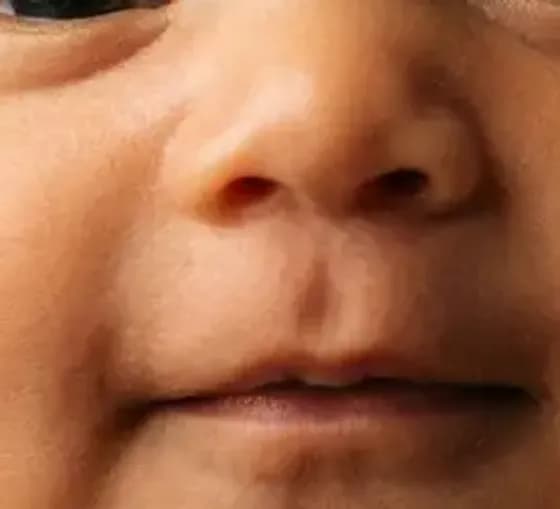 Nose in the AI photo
If you have a scan on your phone right now, you can see a 3D ultrasound as a real-life baby portrait. Details that are unclear or absent in the scan may be estimated.
FAQ
Why does my baby's nose look so big on the 3D ultrasound?
Mostly acquisition and rendering, not a direct measurement of genetics. Surface smoothing can broaden uncertain contours, an oblique probe angle can foreshorten depth, and contact with nearby tissue can flatten and widen the visible surface.
Will my baby actually have a big nose if it looks big on the scan?
Very unlikely to the degree the scan suggests. The scan exaggerates nose bulk, and newborn noses are themselves temporarily wide and flat because the bony bridge hasn't developed and baby fat is at its peak. Adult nose shape settles over years.
Why do newborns have such big or flat noses?
Two reasons: birth compression squashes the face for the first days, and a newborn's nasal bridge is mostly soft cartilage that hasn't risen yet. Both resolve, and the scan face often reappears within a couple of weeks.
Which parts of the nose on an ultrasound are accurate?
A bridge or tip direction that repeats across several clear frames may be useful. Nostril spacing, apparent width and "puffiness" in one surface render are less reliable because angle, shadow, interpolation and contact pressure can change them.
Can a 3D ultrasound tell whose nose the baby has?
Not really. The scan can suggest a broad shape family but can't attribute a nose to one parent, because the defining features develop after birth, and the scan's distortions blur the subtle differences resemblance depends on.
Trusted Medical Sources and Further Reading
For entertainment purposes only. Not medical advice and not a medical diagnosis.