Can ChatGPT Show What Your Baby Will Look Like?
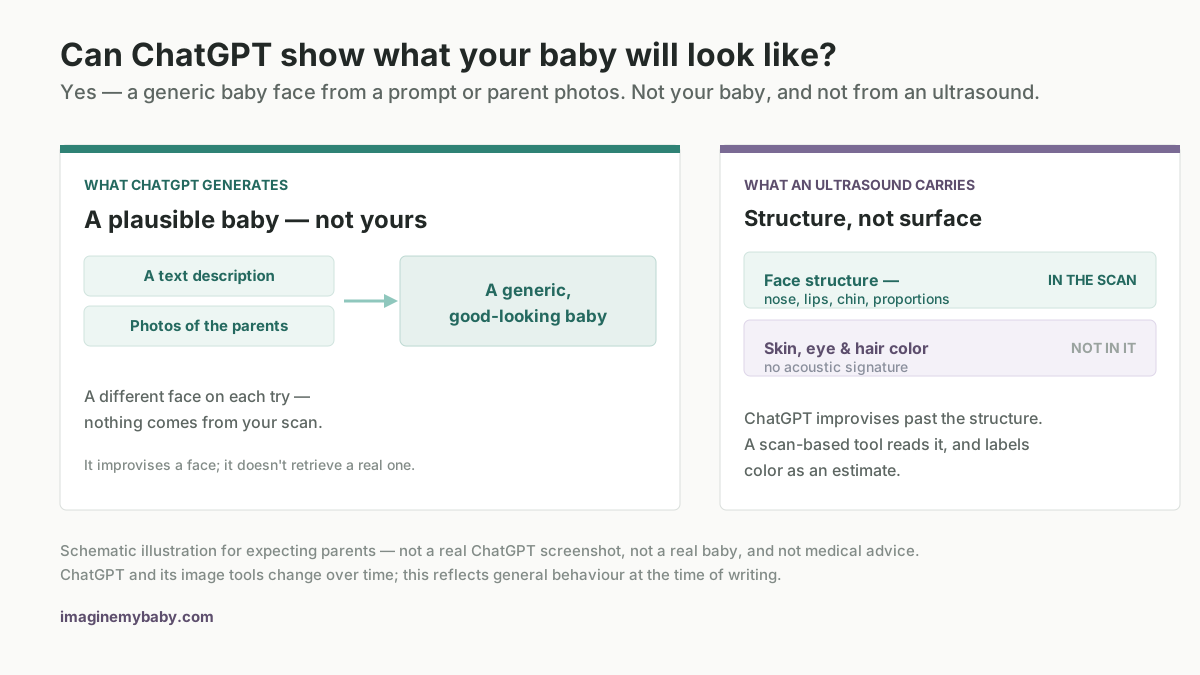
ChatGPT can generate a realistic baby face. What it cannot do is show you your baby, and it doesn't read an ultrasound the way a purpose-built tool does. Ask it to "make a picture of my baby" and you'll get a plausible, cute infant assembled from a text description or from photos of the parents. It's a fun party trick rather than a prediction of the specific child you're carrying, and if you feed it an ultrasound, the face it draws is mostly invented.
This guide covers what ChatGPT can and can't do, where it's useful, and where a scan-based tool does something different.
Can ChatGPT Generate a Baby Picture? What It Actually Does
Yes. At the time of writing, ChatGPT can create images directly, because the image model is built into the chat, so you can describe a scene or upload a photo and ask for a picture back. Give it a prompt like "generate a photo of a baby with brown hair and blue eyes," or upload photos of two parents and ask for "what our baby might look like," and it will produce a believable newborn in a few seconds.
The mechanics are the same as every other AI baby generator that went viral: the model reads the facial features it's given (eye shape, nose, skin tone, hair) and blends them into a new face that looks like it could belong to those people. Some people prompt for a girl or a boy; some ask to age the result up to a toddler or a teenager. It's quick, it's free to try, and the results can be charming.
Two caveats the makers of these tools state themselves: the images are creative visualizations rather than genetic analysis, and they're built for fun.
Why the Result Isn't Your Baby
The face ChatGPT returns is essentially an average of attractive. It has no access to your genetics, so it can't know which of the thousands of variants you and your partner carry, how they'll combine, or where the dice will land. Eye color alone is decided by more than a dozen genes. Two brown-eyed parents can have a blue-eyed child, and no image model can see that coming. What you get is a good-looking, generic baby nudged toward the features you described.
Run the same prompt twice and you'll often get two different children. If the tool truly "knew" your baby, the answer wouldn't change between attempts; it invents a plausible face each time.
None of this makes it useless. As entertainment it's lovely, and playing "who does the AI think our baby looks like?" with your partner is what the tool is good for. Hold the result at arm's length. It's a daydream rather than a preview of a specific person.
Can ChatGPT Read an Ultrasound Scan?
This is where the two ideas get tangled, because plenty of people don't want a made-up baby. They have a 3D or 4D ultrasound and want to see the actual face in it. There's a whole genre of TikTok tutorials telling you to upload your scan and ask ChatGPT to "enhance this to 8K and show what my baby looks like."
ChatGPT can look at the image you upload, but it doesn't reconstruct a face from the scan's geometry. It treats the ultrasound as loose inspiration and improvises a baby, mostly from scratch. The newborn it hands back isn't derived from your baby's facial structure; it's the same generic-baby generator using your scan as a mood board. That's why results swing wildly between tries, and why the face often looks nothing like the one that turns up in the delivery room.
Reading an ultrasound is a specific job. A scan is a map of how sound bounced off tissue, full of shadows, smoothing and probe-angle distortion, rather than a photo. Pulling a real face out of it means working from the structure the scan actually measured: the geometry of the nose, lips, chin and cheeks. A general model isn't built for that, so it does what it is built for and draws something plausible.
A second point applies here too, the same one we make about "8K ultrasound" packages and hair color: some things aren't in the scan at all. Skin tone, eye color and hair color have no acoustic signature, so ultrasound can't record them. Any tool, ChatGPT included, that shows your baby's coloring is guessing at that part. What matters is whether the structure holds up when the surface is admitted to be an estimate.
ChatGPT vs a Scan-Based Baby Tool: Side by Side
Both use AI, so the labels blur. The dividing line is what the tool is built to do with an ultrasound.
| ChatGPT (general assistant) | A scan-based tool (like ours) | |
|---|---|---|
| Best input | A text description, or photos of the parents | Your 3D/4D ultrasound |
| Reads the ultrasound's structure | No, improvises a baby from the image | Yes, that's the job |
| Shows your baby or an idealized one | An idealized, average baby | An interpretation of your baby's facial structure |
| Skin, eye and hair color | Invented, and rarely flagged as a guess | Labelled an estimate, since the scan can't record it |
| Cost | Free tier, with limited daily image credits | Paid packs |
| Photo handling | Uploads may be used to improve the model unless you opt out | Used to make your portraits; deletion on request |
| Consistency | A different baby on each try | One interpretation, from the structure in your scan |
Neither is "the accurate one," because no tool predicts an exact face. The choice comes down to the input you have. If you want to play with parent photos, ChatGPT is a fine toy. If you have an ultrasound and want the result anchored to what the scan shows, use something built for that.
How a Scan-Based Tool Uses Your Ultrasound
We build AI baby photos from ultrasounds, and the rule we work by is that structure comes from the scan while surface detail is labelled as an estimate. Our tool reads the facial geometry your scan captured (nose, lips, chin, the proportions of the face) and turns it into a realistic photo. It's why our side-by-side comparisons of scans and real babies tend to match on shape.
What we don't do is pretend the scan knows things it can't. Eye color, skin tone and hair are labelled as estimates, because the scan never recorded them. It's a keepsake, not a medical image and not a guarantee of exact appearance.
If you want an AI ultrasound photo made from your actual scan rather than a typed description, start with the scan. No account is needed; pick a pack and your portraits are ready in minutes.
How to Get a Better Result From ChatGPT (If You Try It)
Not here to talk you out of it. If you enjoy the process, a few things help:
- Use it for the parent-photo game. Clear, well-lit, front-facing photos of both parents give the model something real to blend. An ultrasound gives it almost nothing usable.
- Be specific in the prompt. Name the age you want (newborn, toddler), the framing, and any features you care about. Vague prompts get vague, generic faces.
- Expect several attempts. Image credits are limited on the free tier, and it can take a handful of tries to get one you like.
- Treat every result as one possibility. The fun is in the range of faces rather than any single one being "the" baby.
And if what you want is your baby's face from the scan you already own, use a tool built for that instead of asking a general assistant to guess.
FAQ
Can ChatGPT make a picture of my baby?
It can make a picture of a baby: a realistic face built from your description or from photos of the parents. It can't show the specific child you're carrying, because it has no access to your genetics, so it produces a plausible, good-looking baby rather than a prediction. Ask twice and you'll usually get two different children, which is the giveaway that it's inventing rather than revealing.
Can ChatGPT read an ultrasound scan?
Not in the way people hope. ChatGPT can look at an uploaded ultrasound, but it doesn't rebuild a face from the scan's actual structure. It uses the image as loose inspiration and improvises the rest. The baby it draws isn't anchored to your baby's facial geometry, which is why the result changes every time and often doesn't match the newborn. Reading a scan's structure is a specific job a general assistant isn't built for.
Is the ChatGPT baby generator free?
There's a free tier, though image generation uses limited daily credits, so several attempts can hit the cap. There is no dedicated "baby generator" feature: you're prompting the general image model, or using a community-made custom GPT.
Is a ChatGPT baby picture accurate?
As a genetic prediction, no, and the makers say as much: the images are creative visualizations for fun rather than analysis. No tool, ChatGPT or otherwise, can predict a baby's exact appearance, and color (eyes, skin, hair) isn't recorded on an ultrasound at all, so any coloring shown is a guess. Treat it as entertainment.
What's the best way to make a baby picture with ChatGPT?
Use it for the parent-photo game rather than the scan: upload clear, well-lit photos of both parents, ask for a realistic baby blending their features, and be specific about age (newborn, toddler). Expect to run it a few times, and treat each result as one possibility among many. For anything based on your actual ultrasound, a purpose-built scan tool will stay closer to the real structure.
Can ChatGPT show my baby's eye or hair color?
No, and neither can any scan-based tool. Eye, hair and skin color have no acoustic signature, so an ultrasound never records them, and a text prompt only shows the color you typed. Color in any AI baby image is an estimate. Structure, the shape of the face, is the only thing a scan carries.