Old Wives' Tales for Gender: Which Ones Are Actually True?
None of them work. Every classic gender old wives' tale, from heart rate above or below 140 to the shape of your bump, sweet versus salty cravings and the ring on a string, performs at about 50%, which is what guessing performs at. The one that's been tested hardest, fetal heart rate, was checked in a 2023 meta-analysis of 4,308 fetuses and came back with no usable difference between boys and girls.
That doesn't make them worthless. They're a fun part of pregnancy, and half of them will be "right" for you by pure arithmetic. This guide runs through the top ten, explains what the data says about the two that have been studied properly, and points you at the three methods that do work.
The Top 10 Gender Old Wives' Tales
| # | The tale | The claim | Verdict |
|---|---|---|---|
| 1 | Fetal heart rate | Over 140 bpm = girl, under = boy | No difference found in meta-analysis |
| 2 | Carrying high or low | High = girl, low = boy | Bump shape is muscle tone, torso length and baby position |
| 3 | Morning sickness | Severe sickness = girl | The only tale with a real (tiny) signal; see below |
| 4 | Cravings | Sweet = girl, salty/sour = boy | No evidence; cravings track deficiency and habit |
| 5 | Skin and hair | Breakouts = girl "stealing your beauty"; glossy hair = boy | Pregnancy hormones affect both, in both directions |
| 6 | Linea nigra | Line above the navel = boy, below = girl | The line is pigmentation from hormonal change, unrelated to sex |
| 7 | Ring on a string | Swinging in circles = girl, back and forth = boy | Your own hand moves it (the ideomotor effect) |
| 8 | Chinese gender calendar | Lunar age × lunar month grid | Tested on 2.8M births: coin flip |
| 9 | Mayan calendar | Age + conception month, even/odd | Same math, same coin flip |
| 10 | Baking soda test | Fizz = boy, no fizz = girl | Fizzing depends on urine pH: diet, hydration, time of day |
Two more you'll meet in forums. The Drano test mixes urine with drain cleaner and reads the color; skip it entirely, because it involves caustic chemicals that release toxic fumes when mixed, it has no predictive value, and there is no safe way to do it at home. And "the toddler knows" is charming and, being a binary guess from a two-year-old, also 50%.
What the Data Actually Says
Most of these have never been formally studied, because there's nothing to study: no mechanism connects bump shape to a chromosome. Two are exceptions worth taking seriously.
Fetal heart rate: properly tested, properly debunked
This is the tale with the most staying power, probably because it involves a real number from a real machine. The claim traces to a 1993 paper suggesting female fetuses ran above 140 bpm, a finding that did not replicate.
The decisive answer came in a 2023 systematic review and meta-analysis in *BMC Pregnancy and Childbirth*, pooling five studies covering 4,308 fetuses. The standardized mean difference in first-trimester heart rate between male and female fetuses was 0.04 (95% CI −0.09 to 0.16, p = 0.553), statistically indistinguishable from zero. The authors' conclusion is blunt: first-trimester fetal heart rate "is not a reliable predictive test for fetal sex determination."
There's a second reason the 140 rule fails even on its own terms: first-trimester heart rates run far higher than 140 for everyone. Across the studies pooled above, the means sat between roughly 150 and 167 bpm for both sexes. A threshold that nearly every early pregnancy clears is not a threshold.
Morning sickness: the one with a real (and useless) signal
This is the exception. Severe morning sickness, specifically hyperemesis gravidarum (the hospital-admission kind rather than ordinary nausea), is associated with carrying a girl. A Swedish study of hospital admissions found a shifted sex ratio among those pregnancies, and the proposed mechanism is plausible: hCG concentrations run higher in pregnancies with female fetuses, and hCG is implicated in hyperemesis.
So the tale has a kernel of truth. It is still useless as a prediction, for two reasons. The effect is a small shift in a population ratio rather than a rule about your pregnancy, and plenty of women hospitalized with hyperemesis have boys. It also applies to severe hyperemesis rather than the everyday queasiness most people mean when they say "bad morning sickness."
Everything else
Bump shape is determined by your abdominal muscle tone, torso length, whether it's your first pregnancy, and how the baby happens to be lying. All of those vary enormously and none of them relate to sex. Cravings, skin changes, and the linea nigra are hormonal, and pregnancy hormones don't sort by fetal sex in any way that shows on the outside. The ring test is a textbook demonstration of the ideomotor effect: tiny unconscious muscle movements in your own hand produce the swing, which is why it "works" so convincingly.
The calendars deserve a note of their own, because they've been tested more rigorously than any folklore has a right to be. The Chinese chart was checked against 2.8 million Swedish births and matched a coin flip across every maternal age and year. The full analysis is on our Chinese gender predictor page, where you can also run your own dates through it. The Mayan predictor is the same idea with simpler arithmetic (mother's age plus conception month, even or odd), and since it also ignores the actual baby, the same accuracy.
Why Half of Them Will Be "Right" for You
It's arithmetic rather than mystery.
Any tale that gives a binary answer is right half the time. Run ten of them and you should expect about five hits. Afterwards, the five that were right feel like evidence while the five that were wrong stop being mentioned. That's confirmation bias at work.
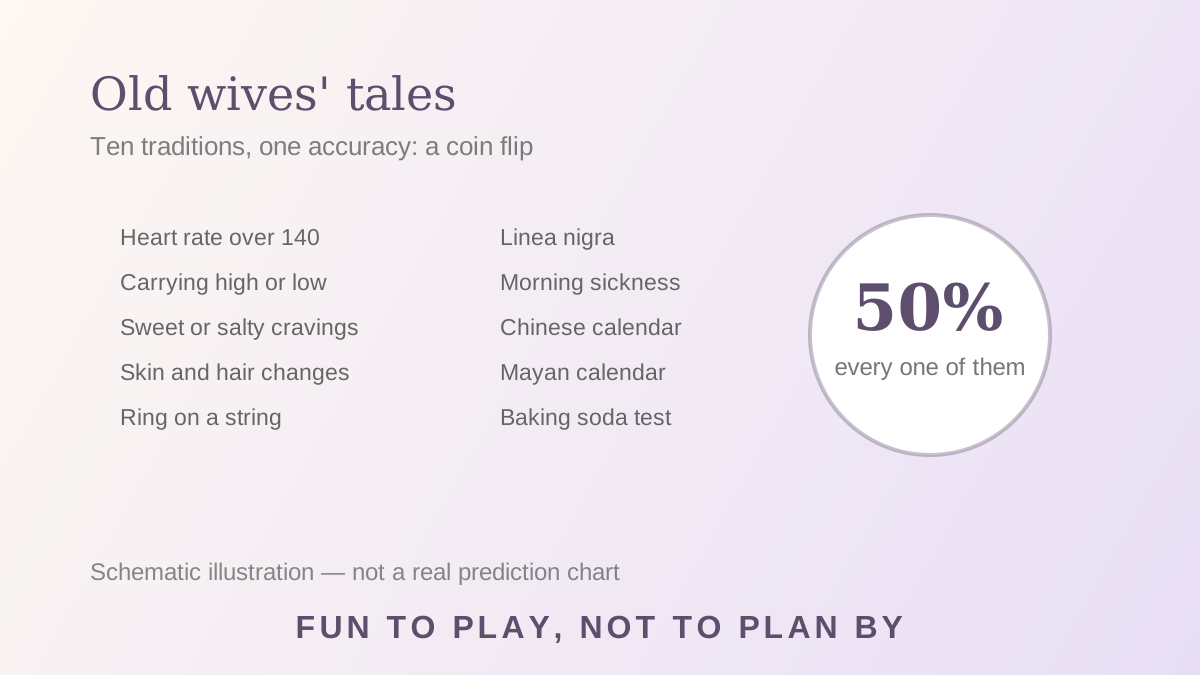
Two more multipliers. Most tales are read after the sex is known, at which point "the bump was definitely low" becomes easy to see. And several are elastic enough to fit either answer in hindsight, since "carrying high" has no measurement attached to it.
Play them anyway if they're fun. Just don't paint the nursery on the result.
The Methods That Actually Work
Three, in order of when you can use them:
- NIPT blood test, from about 10 weeks. Reads fetal DNA fragments in your blood, ~99%+ accurate for sex.
- Nub theory on a 12-week scan. Reads the genital tubercle angle; roughly 87–92% in trained hands, and unreadable on many photos.
- Anatomy scan, 18–22 weeks. Direct visualization, ~99% with a clear view.
The full ladder, week by week, with honest accuracy numbers for each method, is in our guide on when you can find out your baby's gender.
Reading Your Scan Instead of Your Birthday
Folklore guesses from you: your bump, your cravings, your birthday. Our free ultrasound gender predictor looks at your baby, in your scan, for the evidence that's there: the nub angle in the first trimester, visible anatomy later.
And it tells you when there isn't any. A large share of uploaded photos come back "unclear," because the view is wrong, the scan is too early, or the printout is too grainy. No tale on this page will ever do that; every one of them answers with total confidence, whether or not there's anything to go on.
Run your dates through the calendars for fun, then ask the AI what your scan shows.
FAQ
Are any gender old wives' tales accurate?
Effectively none. The most-studied one, fetal heart rate, showed no usable difference between male and female fetuses in a 2023 meta-analysis of 4,308 fetuses. Severe hyperemesis is weakly associated with girls at a population level, but it can't predict an individual pregnancy.
Does a heart rate over 140 mean a girl?
No. A 2023 meta-analysis found no significant difference in first-trimester heart rate between the sexes (p = 0.553). The rule also fails on its own terms: first-trimester rates typically run 150–167 bpm for everyone, so almost every early pregnancy clears 140.
Does severe morning sickness mean a girl?
Slightly more often, at a population level. Hospital-level hyperemesis gravidarum is associated with a shifted sex ratio toward girls, likely via higher hCG. But the effect is a small statistical shift rather than a rule, and it doesn't apply to ordinary nausea.
Is the Chinese gender calendar accurate?
No. It was tested against 2,840,755 Swedish births and performed at about 50%, indistinguishable from a coin flip, across every maternal age and year of conception.
What is the earliest reliable way to find out my baby's sex?
An NIPT blood test from about 10 weeks, at ~99%+ accuracy. On ultrasound alone, meaningful guesses start around 12 weeks with the nub, and near-certainty arrives with the 18–22 week anatomy scan.
Trusted Medical Sources and Further Reading
- First-trimester fetal heart rate and fetal sex: systematic review and meta-analysis (2023)
- Sickness in pregnancy and sex of child (The Lancet, 1999)
- ACOG: Ultrasound Exams
- Mayo Clinic: Noninvasive Prenatal Testing
This article is for entertainment and general information only. It is not medical advice, not a diagnosis, and not a substitute for care from your doctor or midwife. Never use household chemicals, including drain cleaner or bleach, for any home "gender test": mixing them can release toxic fumes and cause serious burns.