Skull Theory Ultrasound: Boy vs Girl Signs and Accuracy
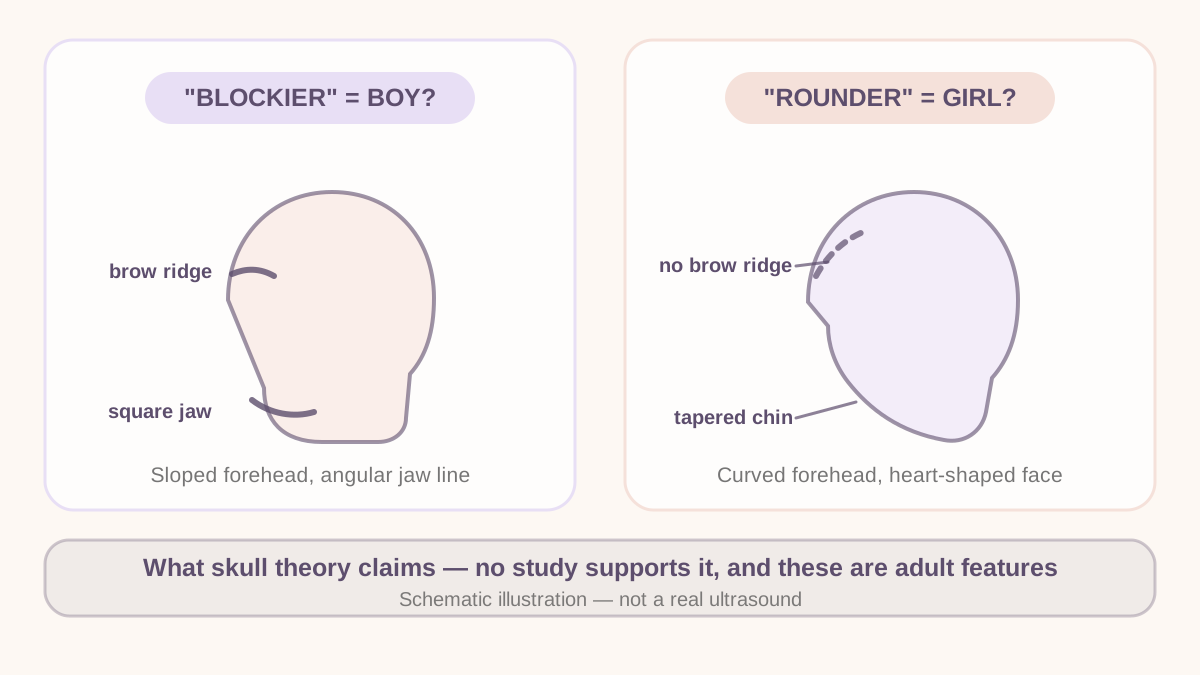
Skull theory says a blockier head, sloped forehead and square jaw mean boy, while a rounder skull and softer jaw mean girl. No clinical trials have verified these indicators on a scan of a fetus. Since there are only two potential results, a 50% rate represents the basic probability of random choice, rather than a proven success metric for skull theory.
The idea is appealing because the head is easy to spot on a 12-week profile. But the theory relies on adult skull characteristics and asks a single, angle-dependent ultrasound frame to show them months before birth.
Skull Theory Boy vs Girl Signs on an Ultrasound
Advocates typically evaluate a 12-week silhouette using the following criteria:
| Feature | Claimed boy sign | Claimed girl sign |
|---|---|---|
| Overall skull | Larger, blockier or more rectangular | Smaller, rounder or tapered |
| Forehead and brow | Sloped forehead with a heavier brow ridge | More vertical, curved forehead with a smaller brow ridge |
| Jaw and chin | Squarer chin and more angled jaw | Rounder jaw and narrower, softer chin |
| Cheeks | More prominent cheekbones | Fuller cheeks relative to the jaw |
These are claims, not proven indicators. The baby's position, probe angle, image scale, and rendering settings can all alter the appearance of the same outline.
How Accurate Is Skull Theory?
No controlled study has established an accuracy rate for predicting fetal sex from skull shape. The frequently cited figures of 70% to 95% come from proponents rather than validated clinical trials. About 50% is the chance baseline for a binary guess, not a measured result from a skull theory study.
Why Skull Shape Cannot Predict Sex at 12 Weeks
Skull theory takes terms such as cranial shape, jaw angle, and brow ridge from the study of mature skeletons. A 2025 CT investigation of one internal skull angle in people from birth to age 30 found that its sexual dimorphism appeared during puberty. That research did not evaluate fetal profiles, jawlines, brow ridges, or skull theory; it shows why a mature skeletal sex-estimation feature cannot be applied as a fetal ultrasound marker.
Ultrasound research does find average size differences between male and female fetuses later in pregnancy. One study covering 5,405 examinations found larger average biparietal diameter, head circumference, and abdominal circumference in male fetuses. It did not test skull theory, and differences between group averages cannot determine one baby's sex from skull shape.
The sonogram itself introduces another complication: the same baby can look different from frame to frame. A steeper forehead can appear if the head tilts toward the transducer. In another frame, the jawline might seem more square. Adjusting the gain can turn a shadow above the eye into what looks like a brow ridge. Much of the apparent signal comes from the image rather than the baby.
Where Skull Theory Came From
No founding scientific paper exists for Skull theory. Instead, it emerged on internet pregnancy boards and gender prediction communities, where users uploaded profile sonograms, made predictions, and sometimes returned after the anatomy scan with the answer.
That feedback loop can look like validation, but it does not record a controlled comparison. Only some users follow up, and correct predictions are more likely to be shared than wrong ones. With two possible outcomes, selective reporting can easily produce a thread full of “skull theory got it right!” posts.
The theory also uses clinical-sounding terms and points to real anatomy on a medical image. That language gives the guessing game more authority than its evidence supports.
What You Can Actually Read on a 12-Week Scan
Skull theory and nub theory read different things. Skull theory evaluates head shape without a validated method, while Nub theory examines the genital tubercle in a suitable mid-sagittal profile. In a study of 656 singleton pregnancies at 12–14 weeks, trained operators could assign fetal sex in 93% of cases; reported accuracy varied with gestational age and the assigned sex. Those findings describe clinical ultrasound assessment, not an AI method.
Clinical blood testing does not depend on the picture. NIPT can report fetal sex from roughly 10 weeks by analyzing cell-free DNA. If you already have a clinical result, analyzing cranial contours cannot improve it.
The anatomy scan uses visible external anatomy. It is typically performed at 18–22 weeks. Our guide to every method by week explains the timeline and limits of each approach.
For those interested in early pregnancy prediction trends, Ramzi theory is another concept frequently discussed in online communities. Although it focuses on placental location instead of the skull, it has likewise failed to prove reliable for identifying fetal sex.
What the Tool Reads on a 12-Week Profile
Our free ultrasound gender predictor deliberately ignores skull shape. It looks for available image evidence, such as the nub angle on an early profile or visible anatomy on later scans, and can return “unclear” when the image does not contain a readable signal. A head shot with no visible nub is such an image. The result is for fun, not diagnosis, and clinical-study accuracy should not be transferred to the AI.
FAQ
Is skull theory real?
While Skull theory is a popular pregnancy prediction game, it is not a scientifically proven technique for identifying fetal sex. No controlled investigation has demonstrated that the shape of the jaw, forehead, or brow on a prenatal sonogram can predict a baby's sex.
How accurate is skull theory?
No rigorous study has confirmed an accuracy rate for Skull theory. A 50% rate represents the base probability of a binary guess, not a verified finding for this theory, and assertions of 70% to 95% accuracy lack support from clinical trials.
What is the difference between boy and girl skull theory?
Proponents claim that male skulls are larger and more angular, featuring a sloped forehead and a square jaw, whereas female skulls are described as rounder, with a gentler chin and a more vertical forehead. These descriptions are unverified as fetal sex markers and remain mere assertions.
Can skull theory work at 12 weeks?
No controlled study shows that skull shape can predict fetal sex at 12 weeks. The mature skeletal characteristics cited by this hypothesis are not verified indicators in a developing fetal profile, and the angle of the sonogram can significantly alter the appearance of both the jaw and the forehead.
Is nub theory more accurate than skull theory?
Published studies support trained ultrasound assessment of the genital tubercle in a suitable profile, while no controlled study validates fetal skull shape. Those clinical results depend on gestational age, image quality, and operator skill, and they do not establish the accuracy of an AI method.
Sources
- Healthline: Skull Theory — Can an Ultrasound Accurately Predict Baby's Sex?
- Sexual dimorphism of the lateral angle of the petrous bone in children: growth patterns (2025)
- Fetal biparietal diameter, head circumference, abdominal circumference and femur length: a comparison by race and sex
- Efrat et al.: Fetal gender assignment by first-trimester ultrasound
Have a 12-Week Profile Shot?
Skip the skull and let the AI check whether your scan holds a readable nub. Free, instant, and clear when there's nothing to see.
Try the free ultrasound gender predictor
This article is general information, not medical advice. Prenatal testing decisions belong with your OB-GYN or midwife.